JOIN the AFICIONADOS
Get the insider news and lowdown on what we've been up to, where we've been, and who we've met along the way. Be the first to discover new places and get the scoop on our favourites.

A room cut open to the sky, an iron man who stayed behind, and a pool that holds the Arlberg upside down. Turrell, Gormley and Snøhetta above Lech, walked in a single day, and the Walser houses to come home to.
Lech made its name on powder, and it has spent the past fifteen years quietly building a second reputation on its summer slopes. First came Antony Gormley in 2010, then James Turrell in 2018, and now the Norwegian architects Snøhetta, each invited up the mountain and asked to change the way we look at it. All three sit within the parish of Lech, all three ask for a climb, and with a little planning you can see them between one sunrise and the next sunset.
This is the round-up. Each work has its own longer story in our Journal, linked below.
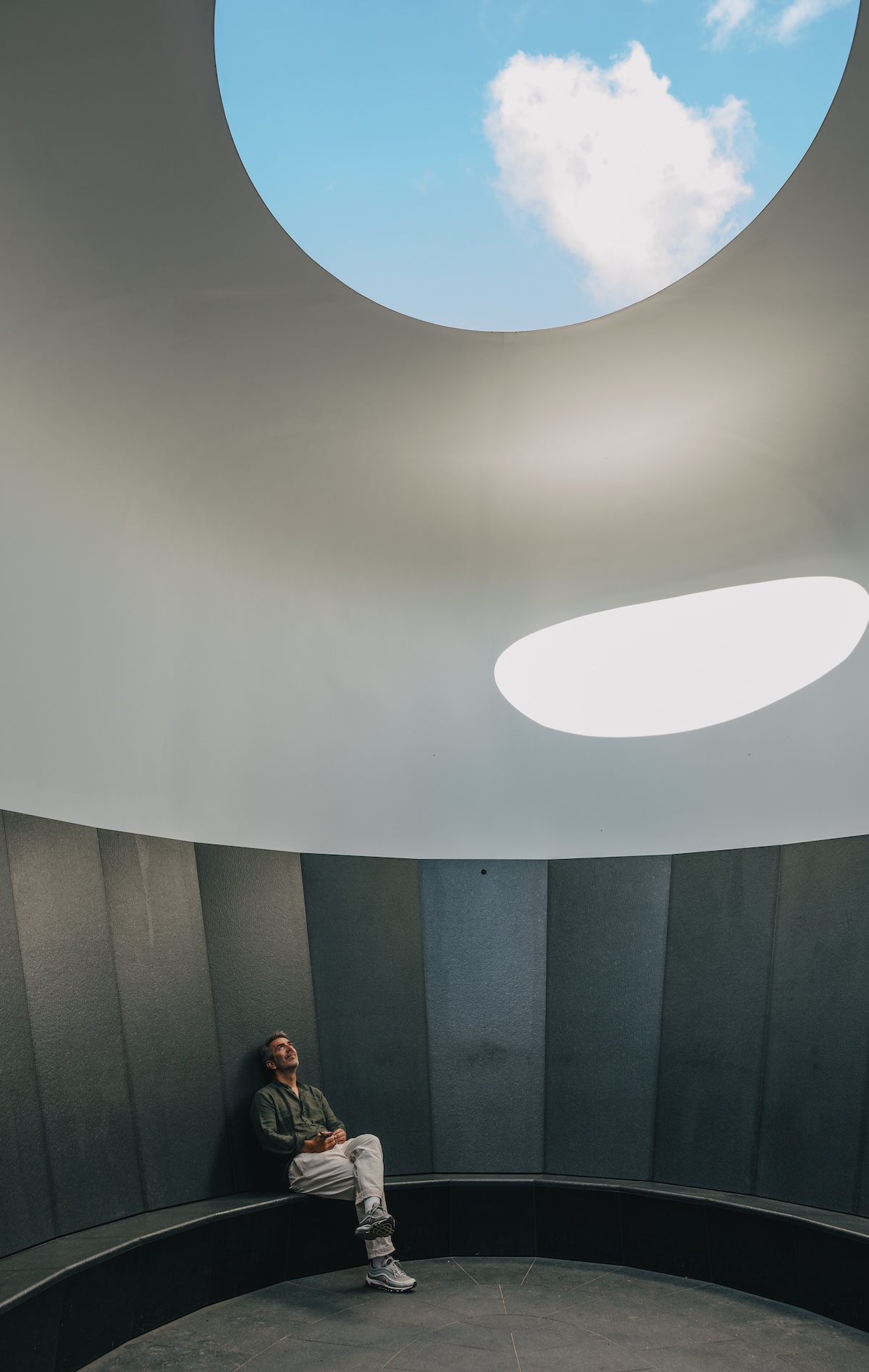
Start early. Turrell's Skyspace sits at Tannegg above Oberlech, at 1,780 metres, almost entirely underground: a 15-metre tunnel leads into an oval room lined in black granite, with a bench around the wall and an elliptical opening to the sky. Book the sunrise session and Turrell's light plays on the walls as the day arrives overhead, a slow 45 minutes in which the colour of the sky becomes very much open to question. Arrive 45 minutes before sunrise; tickets are sold online at skyspace-lech.com or at the Lech tourist office, and the room takes thirty people at a time. Take the bus to its last stop in Oberlech (Schlössle) and walk 15 minutes up; in winter, the Schlosskopf chairlift leaves you ten minutes away.
For Turrell himself, his skyspaces from Antwerp to Salzburg and why a hole in a ceiling can undo you, read Rooms for the Sky.
From the Skyspace, the Lech-Kriegeralp trail climbs on past the Grubenalpe and the Gipslöcher, a field of sinkholes worn into the gypsum, then by the Petersboden lift station and the Der Wolf hut to the Kriegeralpe. The whole walk from Oberlech runs to about three and a half kilometres.
This is where Horizon Field opened in 2010: Antony Gormley's line of 100 life-size figures, cast in solid iron from his own body and set at exactly 2,039 metres across 150 square kilometres of the Vorarlberg Alps. The installation was removed in 2012, but one figure was left behind. Listed in the tourist board's walking notes as Sculpture No. 3, he still stands on the slope above the Kriegeralpe hut, over a small mountain lake, looking out across Lech. He's life size and no larger, which surprises people who come expecting a giant, and the best view of him is from the mountain restaurant's terrace below, ideally over lunch. On the slope beneath him, look for the Lecher Chluppa, a dry-stone wall in which every stone carries the birth date of someone from Lech. The association formed to realise Horizon Field went on to bring Turrell to Tannegg in 2018, so the morning's two works are closer relations than they look.
The full story of the hundred iron men, and the line they drew through the mountains, is in A Line of Iron at 2,039 Metres.
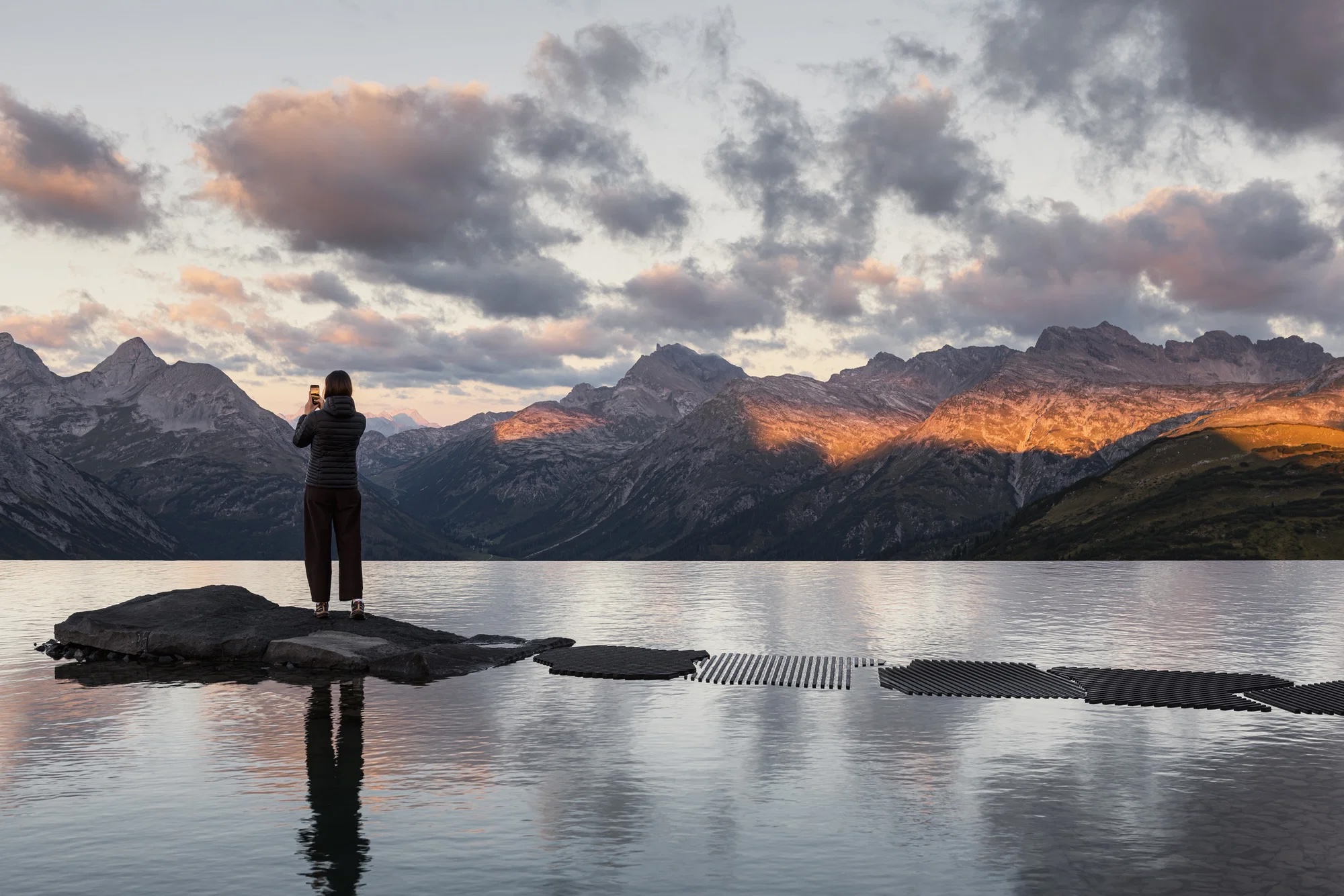
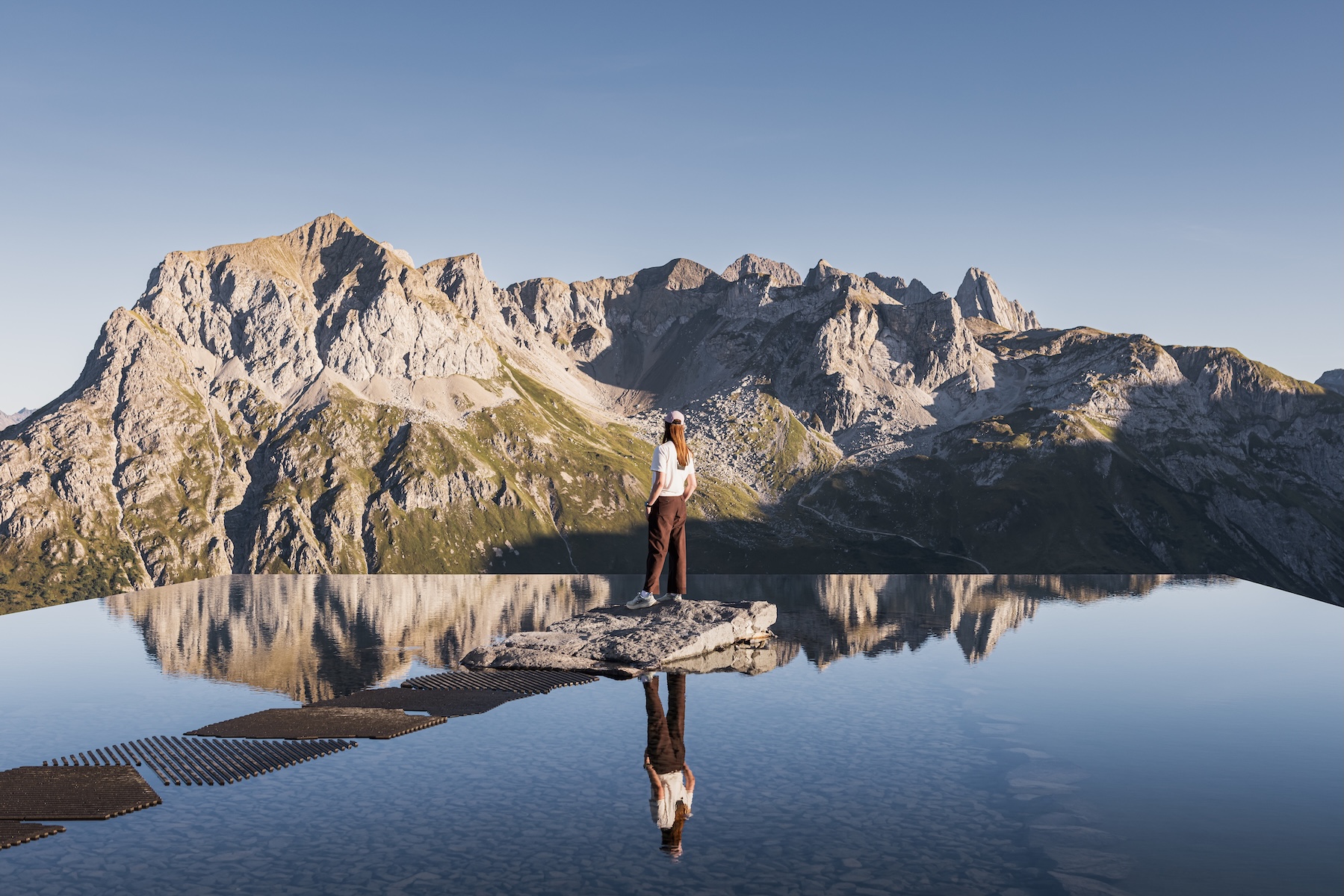
Back down in the valley, make for Zug, three kilometres up the road from Lech, and ride the Zugerbergbahn, which has run in summer as well as winter since 2024. On the roof of its mountain station at around 2,100 metres, beside the Balmalp, Snøhetta's Innsbruck studio has laid a shallow pool. Stepping stones cross the water to a single rock, there's no railing at the edge, and on a still evening the Arlberg appears twice, once where it belongs and once at your feet. Larch benches and boulders invite you to sit, it costs nothing, and on summer evenings the Balm Sundowner keeps the cable car running until 9.30pm, late enough to watch the sunset land in the water. Check the lift's season dates before you plan around it.
For Snøhetta, from the Oslo Opera House to Lech's rooftop, read The Mountain Looks Back.
The day ends close to home if you're staying at Haus W, five minutes' walk from the Zugerbergbahn: a shingled Walser lodge of 1609, rebuilt by its architect owners Katia and Gerold Schneider and opened at the end of 2025. Four bedrooms are let singly by the night, there's a library warmed by a Ducrot stove, and Werkraum Zug offers a fully fitted workspace for those who came to work. Dinner is a short walk up the road at the Klösterle.
Above the village, the Sonnenhof is the Schneiders' other house: a Walser house of 1393, taken whole by the week, with six bedrooms, a Ducrot fireplace and an Ogata sauna cut into the fourteenth-century cellar. It sits beneath the Omeshorn, one of the peaks the Skyspacewas aligned to, which feels about right.
Over the Flexen Pass in St. Anton, Ullrhaus keeps the rest of the Arlberg within reach.
For the winter version of the valley, our ski guide to Lech has the pistes and the White Ring.
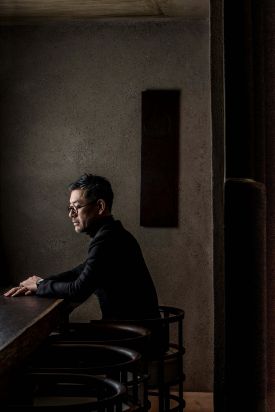
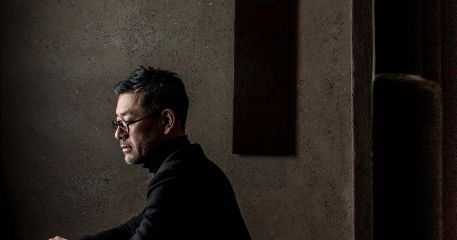
For more than a quarter of a century Shinichiro Ogata and his Tokyo studio SIMPLICITY have shaped how Japanese craft is eaten, served, sold and lived in, from the confectioner HIGASHIYA and the tea house Yakumo Saryo to OGATA Paris. In Lech am Arlberg, that same hand has made a garage, a cellar sauna and a timber screen for two Walser houses.
read more
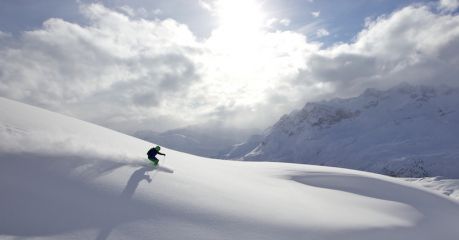
Lech is best known for its skiing and when you include the other Arlberg resorts of St. Anton, St. Christof, Warth-Schröcken and Stuben, which can be reached by Lech-Zürs, there are 340 km of piste and 190 km of off-piste, accessed by 94 lifts.
read more
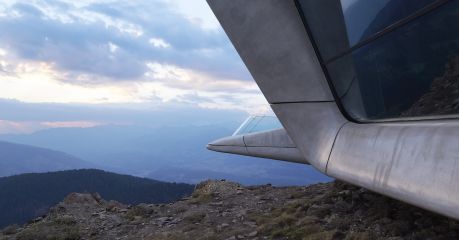
Zaha Hadid's architectural masterpiece atop Kronplatz in South Tyrol, the Messner Mountain Museum, is a concrete designer ode to the history of mountaineering.
read more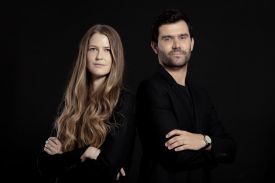
Even though it’s not always easy to spot, the architectural designs of Milan based Peter Pichler Architecture can be considered traditional in many ways. Their sleek, pointed and stark lines may not look it, but they are deeply inspired by nature and by the surrounding vernacular architecture.
read more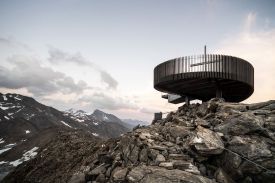
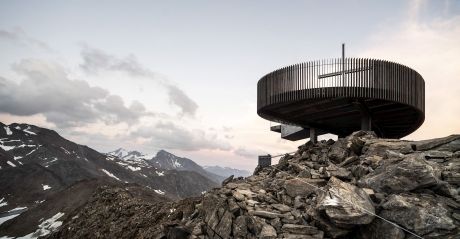
Bold, creative and inspired by the dramatics of their mountain locations - these alpine architecture pitstops are for the design enthusiast.
read more

A sculptural architect with a genius approach to concrete, Walter Maria Förderer’s Brutalist construction of churches in the 60s shows a reinvention of religious buildings that still sits at the vanguard of modernism.
read more

Perched on the snowy ridge of Aiguille du Goûter overlooking the Chamonix valley, this modernist refuge is the last stop for intrepid climbers ascending Mount Blanc in the French Alps, the highest summit in Western Europe.
read more

Made of over 850 glass panels and steel rods, the Nordpark Cable Railway created the world’s largest structures using double-curved glass in construction.
read more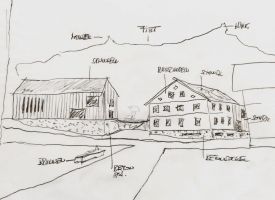
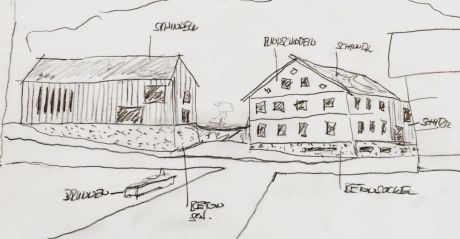
Ten architectural hideaways, from forest pods in Norway to vineyard villas in Alentejo. Alpine modernism, island calm, Lisbon rhythm and one breezy Turkish beauty. Small hotels with big design thinking.
read more

Rome's 'square colosseum', now home to fashion house Fendi's headquarters, is a historic architectural reminder of Mussolini's imprint on Italy's capital.
read more
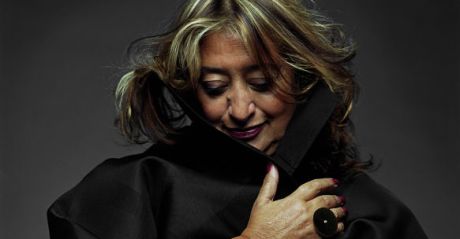
Zaha Hadid Architect's coastal Salerno Maritime Terminal in Cilento, Italy carries her hallmark curves inspired by oysters and the waves, a coastal landmark.
read more

Zaha Hadid's unstoppable design eye and influence is felt here at MAXXI, Rome's premier museum of contemporary art and architecture - worth a peek.
read more
Get the insider news and lowdown on what we've been up to, where we've been, and who we've met along the way. Be the first to discover new places and get the scoop on our favourites.