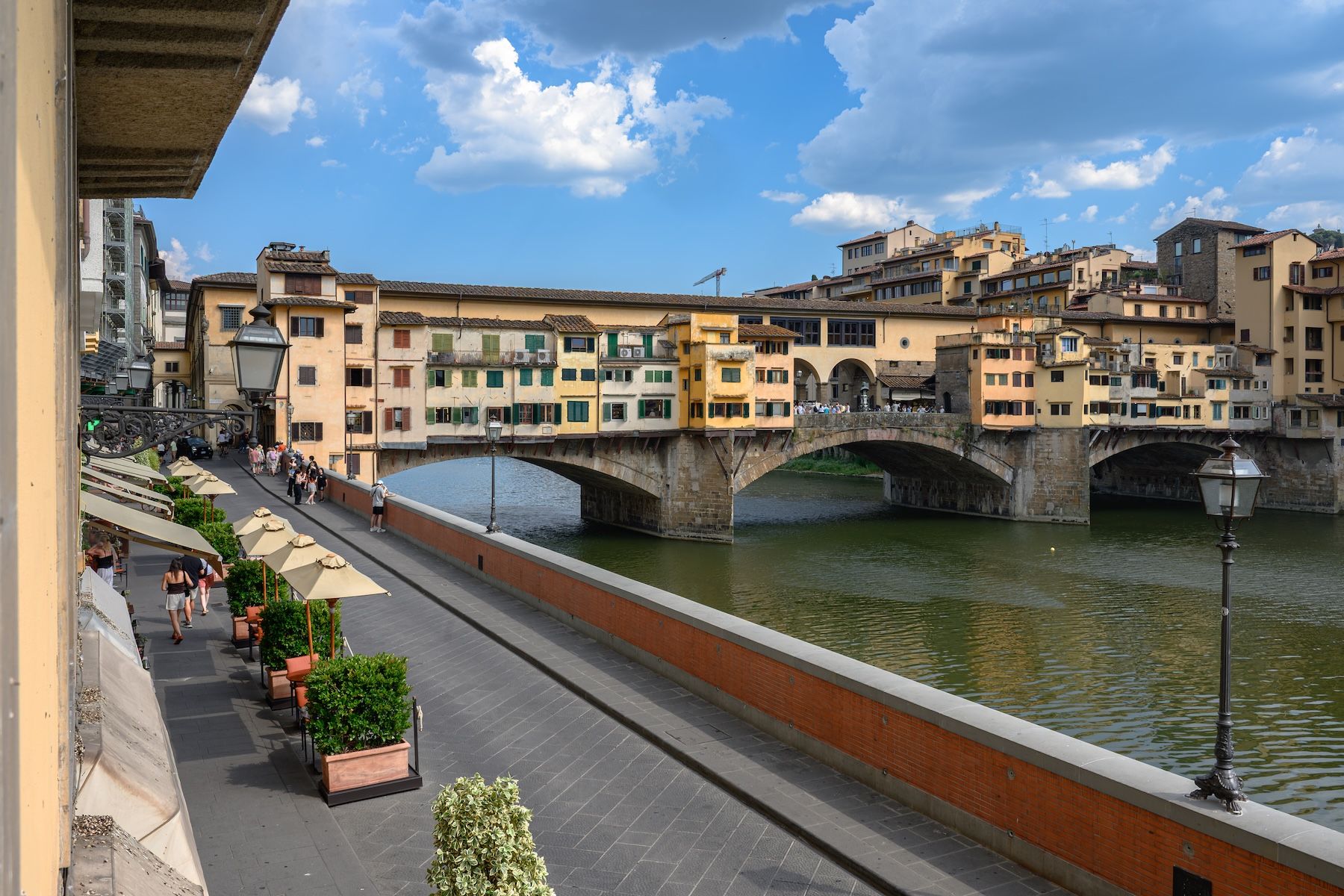
Ponte Vecchio seen from a first-floor balcony on Lungarno Acciaiuoli, its overhanging shops above the Arno and café umbrellas below, images © Tommaso Pini

Whispering Fifties

Intro

Two French balconies, one floor above Lungarno Acciaiuoli, face Ponte Vecchio the bridge Ferdinando I gave to the goldsmiths in 1593, with Cellini’s bust keeping watch in the middle. The building dates from the 1950s, and the apartment Ponte Vecchio Panorama takes that decade as its design narrative. Its 150 square metres are furnished with Italian design of the period, travertine and honey-toned wood, in a palette of celadon and duck-egg drawn from the river outside. Three luxury suites, a living room on the water and a dining room for six make it the most outward-looking of the family's Florence apartments, with the Uffizi two minutes away on foot.

The Reborn Riverfront

Medieval towers and palazzi, among them the riverside palace of the Acciaiuoli, the banking family who gave the lungarno its name once stood on this spot. Florence's post-war reconstruction plans, preserved in the Archivio Storico del Comune di Firenze, covered both Por Santa Maria and Lungarno Acciaiuoli, and the new buildings went up through the late 1940s and 1950s. This one keeps its original entrance and a broad stone staircase, with a lift a few steps up.

At street level, Caffè dell'Oro continues the period theme in a different key: the restaurant of the Lungarno Collection reopened in 2025 with mid-century furnishings, brass and vintage photography. Overhead, a short distance east, the Vasari Corridor crosses the bridge on its way from Palazzo Vecchio to Palazzo Pitti, the private passage Cosimo I de' Medici commissioned in 1565.

Celadon, Travertine & Honey Wood

Fifties dining room at Ponte Vecchio Panorama: glass-topped table on a black lacquered base, brass chandelier, bronze deer on the sideboard and the bridge through the balcony door, images © Tommaso Pini

The living room pairs duck-egg walls with honey-toned wood, run in tall vertical panels, slim pilasters and a fine wooden dado rail, the warm-and-cool pairing of Italian rooms in the 1950s. Travertine frames the windows and balcony doors and rises as a full-height panel beside the dining table, and dark parquet runs underfoot. The original panelled double doors still open from the stair, flanked by black-and-white scenic panels of trees and ruins set into honey-wood frames, like fragments of an old panoramic wallpaper.

The furniture keeps to the decade. A sage-green crushed velvet sofa and a pair of grey wool armchairs on slim tapered legs gather on a geometric rug of sage, charcoal and ochre arcs and stripes, beside a low bench on splayed wooden legs and a round glass side table on brass tripod legs. A brass-and-glass console carries a bronze deer and two rough mineral sculptures on stands. The dining table has a reeded wooden apron beneath its glass top and stands on a sculpted black-lacquered base, with chairs in carved walnut upholstered in blue. Amber glass faceted in the Murano manner, a purple sommerso bowl and a green ceramic vase thick with sculpted olives supply the colour, and an abstract etched mirror in a brass frame hangs in the dining area. The kitchen keeps the period in its materials: flat-fronted cupboards in matt taupe-bronze, a travertine splashback, and an island of travertine cut into a folded, angular form.

Glows of Castiglioni, Murano & Brass

The lighting makes a roll call of the illustrious names of post-war Italian design. Beside the sofa, a tall yellow uplighter rises from a slender tripod, very close to the Luminator that Achille and Pier Giacomo Castiglioni designed in 1955. Bubbled crystal sconces, Murano in style, scatter light across the duck-egg walls. In the bedrooms, black double-cone wall lights with brass collars and articulated brass floor lamps follow the Milanese lighting houses of the period, Stilnovo and Arteluce among them.

Three Suites in Celadon & Sage

Principal suite in sage, its headboard wall gridded with dark wood battens, black cone wall lights and a macassar ebony table set for tea, Ponte Vecchio Panorama, images © Tommaso Pini

A corridor leads from the living rooms to three suites, each quiet behind soundproofed glass, with olive linen at the windows and dark mosaic parquet underfoot, the classic floor of the period. The principal suite is the most graphic: a sage headboard wall gridded with dark wood battens, with a Mondrian rhythm, frames the bed, with a small tub chair in a geometric weave and a round table veneered in macassar ebony by the window, and an open wardrobe shelved in dark wood. In the second, the Suite del Bene, soft-edged padded panels in pale celadon form the headboard against a wall of honey wood; it takes a double or twins. The third is a studio with a single bed and a writing niche, fitted with an ochre leather desk mat, brass candlesticks and an hourglass beneath a small old landscape painting, suited to a teenager or a traveller with work to do. Each suite has a private shower room in marble, grey and beige in the principal suite, light brown and beige in the Suite del Bene, beige and yellow in the studio.

Collectors Who Travel

Gianni and Donatella of Florence Luxury Home on a lawn with their Labrador, among cypresses, olive trees and a large terracotta jar, images © Tommaso Pini

The furniture here comes from the instinct behind every Florence Luxury Home residence. Gianni and Donatella travel often, and the apartments they keep in Florence have to pass the test they set every place they stay: would it feel like home by the end of a week? Their family company gathers a small number of such residences across the historic centre, from the Oltrarno to Santa Croce, each furnished from the objects and period pieces the couple have collected. Here the collecting took a single decade as its brief.

Goldsmiths, the Uffizi and the Oltrarno

Butchers and tanners once worked in the shops on Ponte Vecchio, until Grand Duke Ferdinando I replaced them with goldsmiths and jewellers in 1593, and jewellers hold the bridge still. The Signoria and the Uffizi galleries sit two minutes from the door on the north bank; across the bridge, the Oltrarno leads to Palazzo Pitti, Santo Spirito and the artisan streets of Via Maggio. Ponte Santa Trinita, Ammannati's bridge, rebuilt after the war from stones recovered from the riverbed, is the next crossing west.

editors PICK


Caldaro al Lago/Kaltern View from Seehotel Ambach, South Tyrol Italy Caldaro al Lago/Kaltern View from Seehotel Ambach, South Tyrol Italy
HOTEL - Caldaro al Lago, Italy

Seehotel Ambach


A groovy icon from the seventies, Seehotel Ambach, presides over the shores of Lake Caldaro in Italy’s South Tyrol with its perfectly formed, curvaceous marshmallowy walls of laid-back glamour and a canvas of tangerine, vert and oxide red, which drape mid-century furniture pieces.

read more
JOURNAL

The Tweed Project: Cloud Collars and Craic


On Ireland's Wild Atlantic coast, The Tweed Project reworks indigenous Irish cloth into bombers, kaftans and cloud collars: slow fashion with craic, colour and rebellion.

read more
Ca’n Beneït Mallorca – Historic, Boutique Hotels in the Serra de Tramuntana, Spain Ca’n Beneït Mallorca – Historic, Boutique Hotels in the Serra de Tramuntana, Spain
Hotel - Mallorca, Spain

Ca’n Beneït


A restored Mallorquín estate set within olive groves and terraced hillsides of the Serra de Tramuntana; terracotta floors, honest materials and farm-led dining shape a quietly cultivated rural retreat.

read more
JOURNAL

The best boutique and design hotels in Greece


Whitewashed, sun-drunk and gloriously unbothered: Greece's design hotels trade the crowds for caldera edges, olive groves and marble ruins. Come barefoot, leave changed. Book before everyone else does.

read more

RELATED


view more