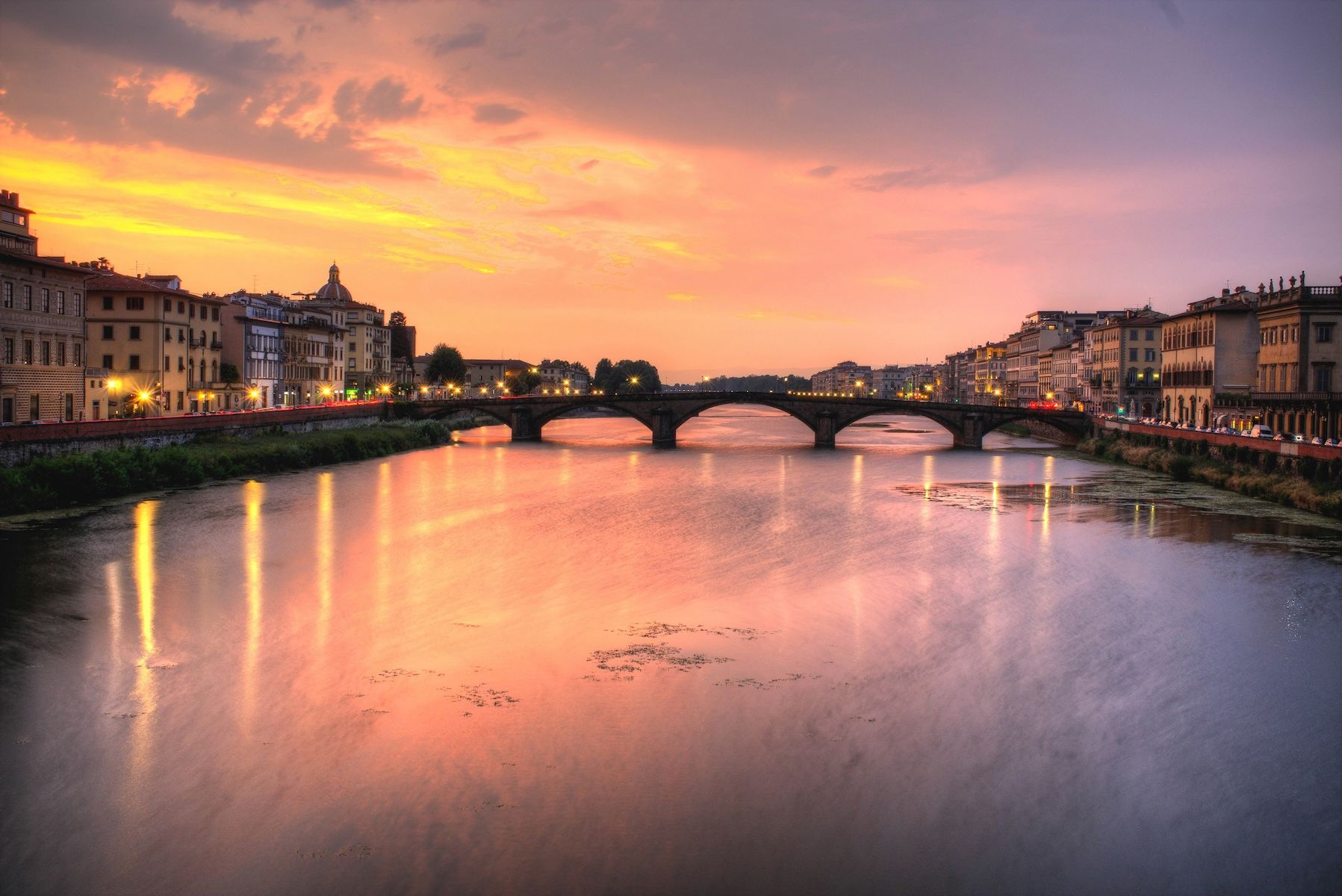
The Arno at sunset from the Lungarno, an arched stone bridge spanning the river between lines of riverside palazzi, their lights reflected in the water beneath a pink and gold sky.

Sgraffito on the River

Intro

From the tall windows of Lungarno Guicciardini 9, the Arno runs straight down to the arches of Ponte alla Carraia, with the palazzi of the north bank lined up opposite and the hills rising beyond: a view that belongs to this stretch of riverbank alone, and one that shifts through the day, from flat morning light on the water to the lamps of the Lungarno after dark. Indoors, all that river light falls on red, the colour of rank in Renaissance Florence: the crimson cloth its merchants grew rich on, the red balls of the Medici shield, the scarlet of the family's cardinals. Here it turns up as oxblood joinery, a brick-red sofa and claret ribbon, held in check by milky and graphite greys. The apartment sits on the third floor of Palazzo Lanfredini, which Baccio d'Agnolo designed early in the sixteenth century for Lanfredino Lanfredini, gonfaloniere of justice, and whose front is worked in sgraffito, plaster scratched through to a darker ground in a pattern of beasts, scallop shells and grotesques. The same architect built the bell tower of Santo Spirito in 1503, and from the bedrooms at the back, across a run of terracotta roofs, his campanile rises beside the church's dome. Since 1917 the piano nobile below has held the library of the British Institute of Florence. A restoration by architects Ilaria Sassolini and Lorenzo Capogrosso hung the bedroom walls in pleated linen, and brought the materials of the Florentine palazzo, carved boiserie, marble and antiqued mirror, across two suites and 140 square metres.

Palazzo Lanfredini: Baccio d'Agnolo on the Arno

The sgraffito facade of Palazzo Lanfredini on Lungarno Guicciardini, Florence, panels of grotesques between pedimented windows above a ground floor scored into mock stone blocks, a carved coat of arms over the door. © Tommaso Pini

Vasari credits the design to Baccio d'Agnolo, the woodcarver turned architect behind several Florentine palazzi of the early Cinquecento, and the building keeps most of its original architecture. Lanfredino Lanfredini kept close control of the work, raising the house on ground his family already held. Its sgraffito is among the best preserved on the Lungarno: the ground floor scored into mock blocks of grey-brown, and above it a grid of octagons and roundels, each holding a creature or a shell, bordered by bands of fret and scroll. Among the beasts is a manticore, man's head on a lion's body. The scheme was restored in the nineteenth century.

The Lanfredini line ended in 1741 with the death of Cardinal Jacopo Lanfredini, and the palazzo passed by marriage to the Corboli, and later, according to the owners, to the Guicciardini, the family who give this stretch of riverbank its name. A period as a hotel followed, then shared ownership with an Englishman named Acton, whose part was left to the British Institute. The Institute, founded by English and Italian scholars, now keeps its Harold Acton Library on the piano nobile, with reading rooms over the river.

An Interior in Sgraffito Tones

The palette reads like the facade brought indoors. Milky and graphite greys dress the boiserie, cornices, dado rails and painted ceiling beams, the pale tones in the walls and upholstery, the darker in the panelling and joinery, with chalk-white plaster above, the same two notes the sgraffito plays outside. The greys have a Florentine pedigree too: pietra serena, the blue-grey stone Brunelleschi set against white plaster inside Santo Spirito, the church in view from the bedrooms, and pietra nera, the black chalk the city's draughtsmen drew with. Against timber the greys make a beautiful pairing: the old ceiling joists, washed pale, run in close ranks overhead, oak parquet laid in a chevron warms the floors, and walnut and oak return in the console, the headboard frames and the bedside tables. Into this the designers bring reds. The strongest is in the kitchen, where the joinery is painted a deep oxblood, red morocco leather darkened by age, and a deeper cousin of cremisi, the kermes crimson that Florence's cloth merchants prized above every other dye. The living-room sofa takes a softer, faded brick red, and claret returns in the ribbons on the coffee table. These pops of red nod to a long Florentine habit of dressing books in red leather. When Cosimo I opened the Laurentian Library to the public in 1571, the Medici family's manuscripts, some three thousand of them, were rebound in red leather stamped with the family arms and chained to Michelangelo's reading benches; the faded spines of the old books kept around this apartment belong to the same tradition.

The living room's set piece is a painted landscape wrapped across two walls above a grey dado: cypresses, umbrella pines and rolling Tuscan hills in pale green-grey, worked almost in grisaille so that the scene dissolves upward into clouded plaster. Grey tweed wingbacks with navy velvet cushions, a table of glass and brass and an ivory and indigo rug sit beneath it, with an oval marble table for dining under a wrought-iron chandelier. The dining corner turns darker and richer: graphite panelling, cabinet doors glazed in gold honeycomb glass and lit from within, a large gilt oval mirror between brass sconces, twisted-stem glasses with gilded knops and silver candelabra. A walnut console holds a brown transferware platter and a stand of pomegranates.

The corridor is floored in marble. The kitchen glazes its oxblood cabinets with antiqued mirror, foxed and held by small rosettes, so that light travels around a narrow room. Carrara lines the wall behind the counters, with a brass rail hung with linen cloths.

A Florentine Paper Trail

A bundle of printed decrees of the Kingdom of Italy issued under Umberto I, stamped with the Savoy arms and tied in claret ribbon, on a glass and brass table at Lungarno Guicciardini 9. © Tommaso Pini

Some of the most telling objects in the apartment are its smallest, and together they make a short chapter of the city's history, laid out on tabletops. On the coffee table, bundles of printed decrees of the Kingdom of Italy, stamped with the Savoy arms and numbered as laws, are tied in claret grosgrain, a reminder that Florence served as capital of the new kingdom for six years from 1865. Beside them, old books in worn red half-calf and marbled boards rest beneath a pewter candlestick. On the console in the dining corner, a young woman's head and shoulders in white plaster, her hair swept up, catches the afternoon light.

Paper goes deep in Florence. Its merchants set down their lives in ledgers and family memoirs, the ricordanze, and the city's archives and libraries grew from that habit of record. The craft survives a short stroll away on Piazza Pitti, where Giulio Giannini e Figlio has bound books and made marbled paper since 1856, its early customers drawn from the foreign literary colony that settled in nineteenth-century Florence. Lower down in the same palazzo, the British Institute keeps its library of books in English. Read together, the plaster head, the books and the ribboned papers make the apartment feel married to the history around it, as though the building's long life of reading and record-keeping had found its way upstairs.

Draped Walls: Two Suites Facing Santo Spirito

The living room at Lungarno Guicciardini 9, a brick-red sofa beneath a misty painted landscape of cypresses and hills, a glass and chrome table set with books, ribbon-tied papers and dried hydrangeas on an ivory rug. © Tommaso Pini

Both suites take the quiet side of the building, over an internal courtyard and the roofs beyond, and in both the walls are hung floor to ceiling in pleated linen. The effect is theatrical, a stage curtain in linen, and recalls the old palazzo habit of dressing walls in fabric; in one room a concealed light rises behind the headboard and up through the folds, so the whole wall glows at night. One window frames the dome of Santo Spirito, another the campanile. A double bed furnishes the principal suite; the second converts between a double and twin singles. Headboards are grey upholstery set into oak and bronze, a small slipper chair stands on carved cabriole legs, and antiqued mirror panels wrap the wardrobes. The bathrooms are lined in a boldly veined white marble, with brass wall taps, a vanity of warm beige stone and an oval glass flanked by brass wall lights. A fifth guest can sleep on the living-room sofa bed.

Florence Crafted

Gianni and Donatella of Florence Luxury Home in a garden of cypresses and olive trees, kneeling on the lawn beside their Labrador,

The respect for handwork running through the restoration suits the owners. Gianni and Donatella, the family behind Florence Luxury Home, furnish their apartments with pieces that show how they were made, and they favour furniture that has been used, repaired and passed on. In a building whose facade was scratched into plaster by hand five centuries ago, the habit fits. The Oltrarno outside keeps the same instincts, with leather workers, goldsmiths and marbled-paper makers still trading in the streets around Santo Spirito.

Via Maggio, Santo Spirito and Palazzo Pitti

Via Maggio, close to the door, is the antiques street of Florence, its windows filled with restorers' work and period furniture. At the top of the neighbourhood stands Santo Spirito, Brunelleschi's basilica, with a piazza of cafés and wine bars in front of its plain facade, and a short way east, Palazzo Pitti and the Boboli Gardens. Ponte Vecchio lies just upriver, the Duomo and the Signoria about ten. Santa Maria Novella station is a quarter of an hour on foot across Ponte alla Carraia.

editors PICK


JOURNAL

Artisan of the present, with the soul of the past


Working from Malasaña, Javier Sánchez Medina creates contemporary objects from natural fibres, guided by esparto grass, inherited craft knowledge and a deep respect for material, process and time.

read more
Maison Duroy exterior spring view pink Judas tree blooms honeyed stone facade vert de gris shutters Gascogne countryside | The Aficionados Maison Duroy exterior spring view pink Judas tree blooms honeyed stone facade vert de gris shutters Gascogne countryside | The Aficionados
Guesthouse - Gascogne, France

Maison Duroy


Like a watercolour painting of the perfect Gascon guesthouse. Former Henri IV hunting lodge where Swiss hosts blend mid-century design with centuries-old stone architecture.

read more
Modernist Furniture | Cool Hotel Design Interiors at boutique Hotel Julien Antwerp, Belgium Modernist Furniture | Cool Hotel Design Interiors at boutique Hotel Julien Antwerp, Belgium
HOTEL - Antwerp, Belgium

Hotel Julien


A Flemish icon redefined – Hotel Julien is Antwerp’s creative townhouse bolthole, where design, heritage and mood collide in the city’s historic core. Intimate scale, rooftop views and total style.

read more
JOURNAL

Dinner in a Recipe Box: Falling for Francy's at The Venice Venice Hotel


The Venice Venice Hotel's after-dark alter ego: the hottest seat on the Grand Canal, home to the creative set, arty glamour and Venetian insiders.

read more

RELATED


view more