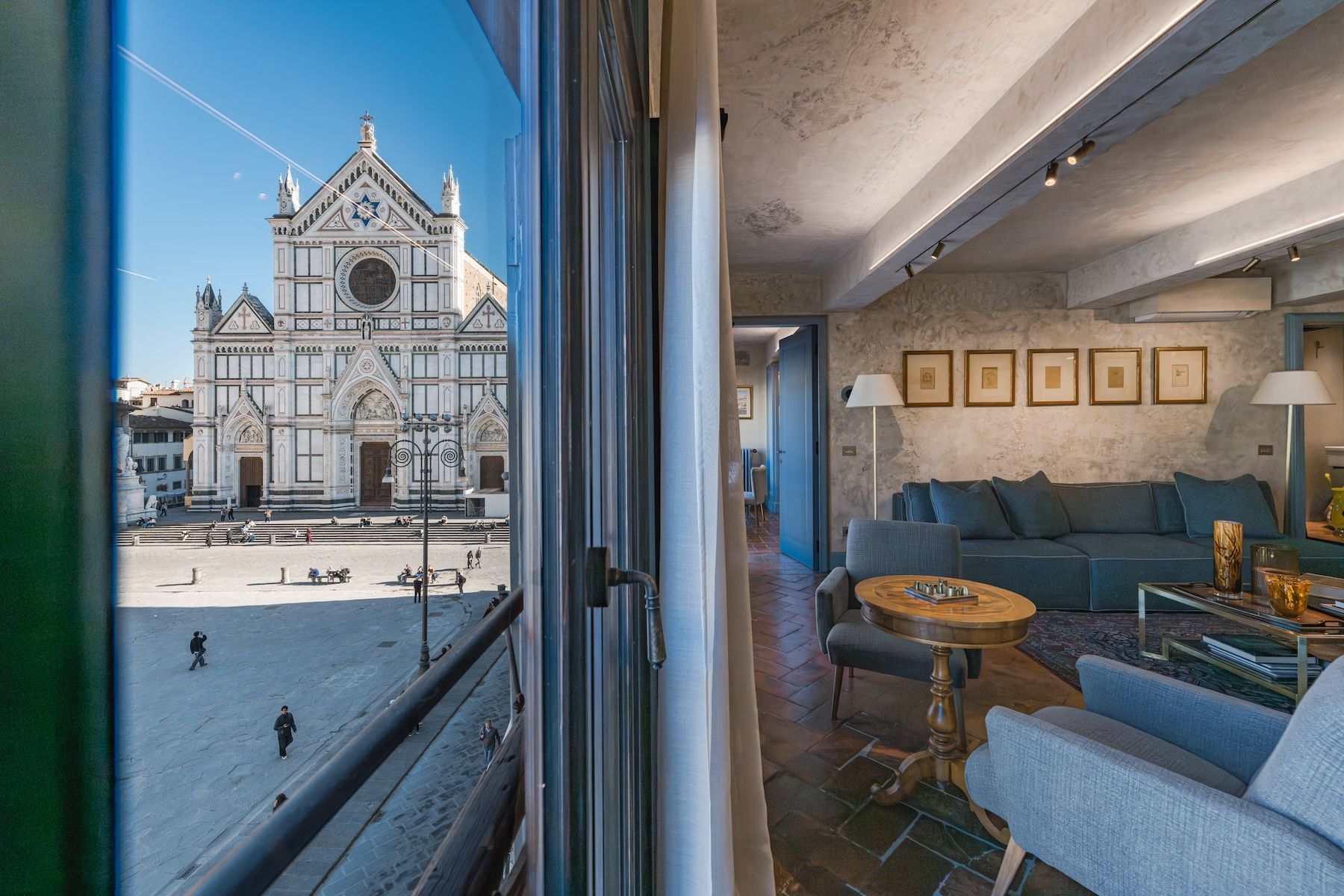
An open window at Santa Croce Historical Home framing the Basilica of Santa Croce across the piazza, beside a living room with blue sofa, walnut games table, terracotta floor and five framed drawings.

Piazza Theatrics

A painted nineteenth-century bust of a young man in coat and cravat, set in a carta da zucchero blue niche at Santa Croce Historical Home between volumes of an Italian encyclopaedia.

Intro

Vivid and laced with history, the apartment Santa Croce Historical Home wraps centuries of Florentine heritage in a rich contemporary voice. During the renovation of this second-floor residence in Palazzo dell'Antella, a fragment of fresco surfaced beneath later paint: dark foliage on a blue-grey ground. That blue is carta da zucchero, the chalky sugar-paper shade of old Italian interiors, and it now runs through the apartment, lifted off the plaster and onto every door and cornice. The setting is a front-row seat on Piazza Santa Croce, at the centre of the old Santa Croce quarter, facing the Basilica across the square, the Franciscan church where Michelangelo, Galileo and Machiavelli are buried, above a piazza that has staged markets, processions and, every June, the Calcio Storico for centuries. The palazzo's own front is one of the few painted facades left in Florence, its allegories, putti and garlands of fruit and flowers set down in fresco in 1619 and 1620 around a marble bust of Grand Duke Cosimo II de' Medici above the door. Behind it lies a generous 300-square-metre apartment, with five suites under painted ceilings, designed for the family clan or for friends travelling together. For anyone who comes to Florence for the Renaissance and the centuries that followed it, the address answers the brief on every count.

Palazzo dell'Antella: A Facade Painted in Twenty Days

The palazzo grew out of a row of medieval houses and gained its top floor late in the sixteenth century. Early in the seventeenth century, Costanza del Barbigia brought it as her dowry to the senator Niccolò dell'Antella, who bought the house next door and engaged Giulio Parigi, architect and stage designer to the Medici court, to join the two. The facade followed in 1619 and 1620, painted under the direction of Giovanni da San Giovanni by a team that included Domenico Passignano, Matteo Rosselli, Ottavio Vannini, Fabrizio Boschi and Michelangelo Cinganelli. Tradition holds that they finished in about twenty days. The programme amounts to a moral portrait of Cosimo II, and his bust above the portal anchors the whole composition.

Details reward a slow look. The windows sit closer together as they approach the Basilica, a perspective device that stretches the front when seen from the church steps. Set into the wall, a marble disc dated 1565 marks the halfway line of the Calcio Storico pitch, giving the building a fixed role in the city's oldest game. After the dell'Antella line died out late in the seventeenth century, the palazzo passed through the Della Stufa, Mariani, Dal Borgo and Cinelli families, and in 1925 the Cinelli commissioned Amedeo Benini to restore the paintwork. The Piccolomini, the Sienese family of Popes Pius II and Pius III, have owned it since the middle of the twentieth century. Out of sight of the piazza, a walled rose garden survives within the block, closed in on all four sides.

Frescoes and Carta da Zucchero

Faded fresco recovered during restoration at Santa Croce Historical Home, a stencilled frieze of foliage and green bands on the wall, traces of blue on the ceiling above.

The renovation began by deciding what to preserve, what to keep and nurture: this was the beginning of the design narrative, whilst removing the layers that didn’t belong. The source of the blue survives beside a doorway: dark foliage painted over a blue-grey ground above a dado, its tone matched so closely by the new door frame next to it that the two read as one surface. The same shade follows the skirting, through the built-in joinery and into the corridor niches, a thread that ties one room to the next. Along the front, full-length windows open onto the piazza behind iron balconettes, with sheer linen softening the light. Underfoot, terracotta laid in herringbone runs from room to room, the traditional floor of a Florentine house of this age and patina, its warm red beneath walls and beams finished alike in a mottled grey plaster; the corridor switches to oak parquet.

The furnishing mixes a gilded past with quieter contemporary notes, in a collector's mix that spans three centuries. In the living room a longcase clock in an inlaid case stands between the windows, a gilt mirror and a pair of altar candlesticks dress the grey stone fireplace, and Italian mid-century armchairs on splayed legs, some in blue velvet, gather with their footstools around a two-tier brass-and-glass table on old Persian carpets. Faceted amber glass, an ammonite fossil and a small cast of a child's head fill a mirror-backed display cabinet, and five small drawings in gilt frames hang in a row above the sofa. Along the corridor, a plaster bust of a woman stands in a niche painted the same blue, beside an exposed stone door surround and an antique settle cushioned in blue-and-white ticking. The dining room gives one wall to brown transfer-printed plates and platters, with more in a lit blue alcove, while a gilt figural clock keeps the mantel and dark candelabra stand on a Carrara marble table. Linen upholstery, brass track lights and concealed strips along the beams supply the contemporary side, light enough that the apartment belongs to no single century.

Ochre & Carrara

The ochre kitchen at Santa Croce Historical Home, a carved grey marble double sink, brass wall tap, Carrara splashback, range cooker and old terracotta brick floor beneath limewashed beams.

Ochre warms the kitchen: panelled cabinets in deep ochre with brass cup handles, Carrara marble on the splashback and worktops, a double sink carved from a darker grey marble, and an unlacquered brass tap mounted on the wall. Old terracotta brick covers the floor, the beamed ceiling is limewashed, bullseye glass fills the window, and copper pans and iron skimmers hang from a rail above the range. A terracotta head watches from a shelf.

Five Fabulous Suites

A suite at Santa Croce Historical Home with a pale blue bedcover, a headboard wall hung in lit silver-grey drapery, blue-grey door frames and herringbone parquet leading to a marble bathroom.

Each suite comes with a private marble bathroom and shower, plus a theme and palette of its own, and in several the recovered painting does the work of a headboard. In one, the bed stands against an uncovered wall scheme of red and sea-green stripes, painted to imitate striped silk, framed by bronze-finish panels that carry the reading lights, with a carved column lamp in worn green paint alongside. In another, a faint foliate fresco covers the walls, gilt bronze sconces flank a blue-framed door, and the bathroom beyond has twin basins and brass taps. Suite 1 is the one with the view: at the front of the building, its windows open over the piazza to the Basilica, and it sleeps two in a double or in a pair of singles. Suites 2 and 3 sit mid-plan above the interior courtyard, and Suites 4 and 5 face the courtyard from the back, the quietest rooms in the apartment. Two of the suites take a trundle bed, which lifts the count from ten guests to twelve. Acoustic glazing, cooling and smart televisions are fitted throughout, and a small study with a printer serves anyone who has to work.

Table x Twelve

The dining room at Santa Croce Historical Home, a Carrara marble table for twelve beneath timber beams, blue-grey cabinets and walls of brown transferware, a stone fireplace and a glimpse of the ochre kitchen.

The dining table seats twelve, and it says most of what needs saying about how Gianni and Donatella approach a stay. The couple run Florence Luxury Home as a family business, and here the kitchen is fitted for real cooking: a gas range, a generous oven, a wine fridge, and a bound book of the family's own recipes left out for guests to work through. The red on the counter is a Chianti from the family's vineyard, bottled under the house label. Groups who would sooner be cooked for can hand the range to a private chef for the evening, and cooking classes and guided walks are arranged on request.

Leather, Calcio Storico and the Goldsmiths

The Santa Croce quarter has worked leather for centuries, and the Scuola del Cuoio, set inside the Basilica complex, still trains craftspeople and sells their work. Goldsmiths and antique dealers occupy the streets around it, along with trattorias where bistecca alla fiorentina is the point of the evening. The square keeps its own calendar. In June the Calcio Storico Fiorentino takes it over, teams in Renaissance costume playing on a pitch of sand; from mid-November until the end of December a Christmas market fills it with stalls and lights. Ponte Vecchio and the Uffizi are an easy walk west.

editors PICK


The Greenwich Hotel, New York | Luxurious Lodgings of TriBeCa The Greenwich Hotel, New York | Luxurious Lodgings of TriBeCa
Hotel - New York, United States of America

The Greenwich Hotel


A combination of country house familiarity and urban chill. A designer orchestration of salvaged pieces, crafted textiles, aged ceramics and bespoke furnishings that are housed in a traditional red-brick new build – this new luxury kid on the block gives TriBeCa the unpretentious grand hotel it so craved.

read more
JOURNAL

KUKAS | FORM AS EMOTION - Portugal’s quiet iconoclast


KUKAS shattered tradition with jewellery that’s sculpture, architecture and rebellion. Her visionary legacy pulses on—raw, bold, timeless. Geometry that wears its attitude loud.

read more
The Brecon Adelboden | Images, Interiors, Restaurant, Rooms The Brecon Adelboden | Images, Interiors, Restaurant, Rooms
Hotel - Adelboden, Switzerland

The Brecon


An adults-only hotel-chalet chameleon married to a curatorial melange of mid-century nostalgia and a dialogue of soft luxury perched in altitudinous Adelboden.

read more
Dun Aluinn Aberfeldy Scotland | Hotel & Luxury Private Estate for Exclusive Hire in Perthshire Dun Aluinn Aberfeldy Scotland | Hotel & Luxury Private Estate for Exclusive Hire in Perthshire
Hotel - Perthshire, Scotland

Dun Aluinn


Lose yourself in a world where heritage collides with bold design. Think roaring fires, statement interiors, and epic views—this isn’t just a stay, it’s an experience that redefines escape.

read more

RELATED


view more