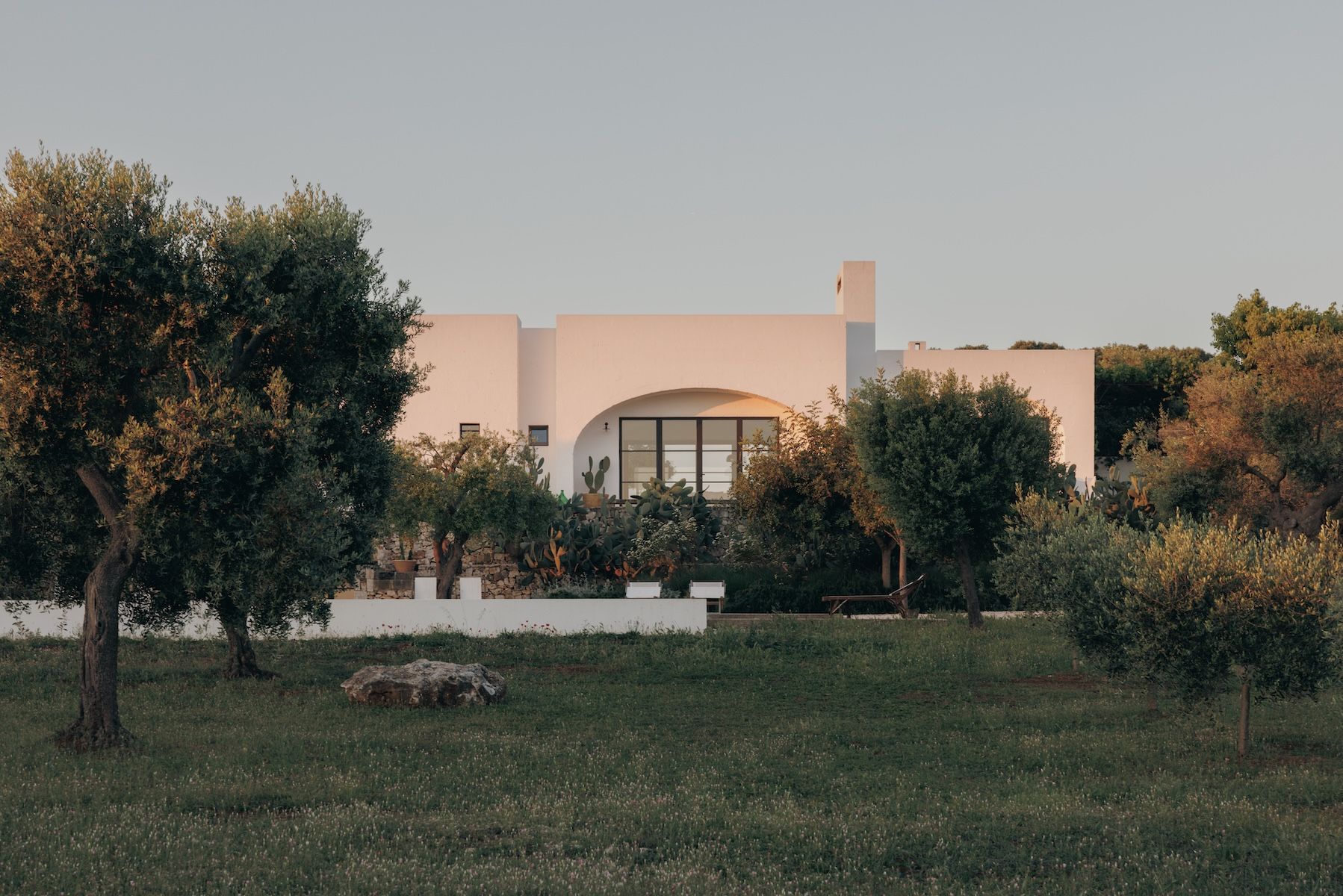
S/un Set over the rural guesthouse-hotel Masseria Moroseta caught pink in the dusk light, its arched Crittall window framed by olive trees and prickly pear, near Ostuni, Puglia | The Aficionados.

Limewashed Olives

The single pivoting gate set into the whitewashed perimeter wall of Masseria Moroseta, opening onto the gravel courtyard, potted citrus and pale staircase, Ostuni, Puglia | The Aficionados.
A canvas of limewashed walls set against noir and raw stone, hand-thrown ceramics, olive trees and the shifting hues of a working organic grove of 5 hectares, the Adriatic opening out beyond: this is the scene Masseria Moroseta sets, sitting humbly on a soft ridge above Ostuni, the white citadel of Puglia.

Intro

A canvas of limewashed walls set against noir and raw stone, hand-thrown ceramics, olive trees and the shifting hues of a working organic grove of 5 hectares, the Adriatic opening out beyond: this is the scene Masseria Moroseta sets, sitting humbly on a soft ridge above Ostuni, the white citadel of Puglia. We have affectionately christened the guesthouse-hotel and its villas the matriarch of sweet simplicity, and the fondness is widely shared. The house has conquered the centrefold of every glossy going, from Dezeen and Domus to Architectural Digest and Surface, and Andrew Trotter’s particular brand of Mediterranean Modernism now carries its own Gestalten monograph.

Created by two friends, owner Carlo Lanzini and architect Andrew Trotter, what began some ten years ago has since unfolded into several chapters, with standalone villas now dotted across the surrounding countryside. Moroseta did not follow the Apulian script so much as rewrite its DNA. It cracked the formula of rustic climbing into bed with tradition against a minimalist seduction, a blueprint: the art of simply being, rather than trying too hard, of embedding a modern ruralism without crowding out the thing it loves.

Like the thyme, rosemary and lentisk shrubs that root in the seams of the dry-stone walls, the house has rekindled a natural, holistic presence, its unobtrusive buildings anchored to the ancient olive groves and tuned to a rhythm you will find only in Puglia, and only then if you know where to look. Carlo wanted somewhere to host dinners for his friends and gather them, a place that took craft and creativity seriously and itself rather less so, with none of the stereotyped interiors of the boutique circuit. That first thought is held and ever-present. 

Casual, chilled and soulful, the Masseria and its villas speak the same articulate formula: basecamps for those who understand that simplicity is, in itself, the original beauty of Apulian life, scripted in chalked whites.

The Grammar of Lanzini & Trotter

Owner Carlo Lanzini and architect Andrew Trotter on a concrete bench against a limewashed wall at Masseria Moroseta, Ostuni, Puglia | The Aficionados. Raised pool and timber loungers above an olive grove running to the Adriatic at dusk, Moroseta, near Ostuni, Puglia | The Aficionados.

The stillness was authored by two people. Carlo Lanzini, raised in the Brescian countryside and trained in London as a cinematographer, came down to Italy’s ancient heel for what was meant to be a single night, woke to a quality of light he had met in neither city, and resolved, on the spot, to live in it. He had always pictured a house big enough to fill with friends. When he found his piece of land below Ostuni, he called Andrew Trotter, a friend of twenty years, and asked him to help find an architect. Trotter (Yorkshire-raised, schooled in the studios of Anouska Hempel and Yohji Yamamoto, latterly behind the Barcelona magazine Openhouse, and founder of Studio Andrew Trotter) proposed himself. Four years and one rejected scheme later, the house opened in 2016, and the design world promptly lost its head over it.

Trotter’s brief was disarmingly modest: a building that would not embarrass itself among trees that predate the unification of Italy. He read the masserie of the region, the old, fortified farmsteads that have ordered Apulian country life for centuries and borrowed their logic rather than their look. What stands on the ridge is neither pastiche nor provocation. It is a farmhouse that argues, convincingly, that it has always been there.

The vocabulary is short, and every word is local. Tufo, the regional sandstone, laid 60 centimetres thick so the walls breathe and cool themselves. Chianca limestone underfoot. Calce lime, where the Romans would have reached for it, dry stone, where the farmers always have. Vaulted ceilings, dark Crittall windows holding the light, kenaf in the cavities and panels on the roof drinking the sun. The single front gate is a relic of a defensive instinct, from a century when the threat lay nearer than the next village. Cooling is mostly a matter of cross-breeze; the machinery is there, but rarely needed. Every material was found within reach and shaped by hands that live nearby.

Pared to the Bone

Le Corbusier LC4 chaise in cowhide beside the fireplace, with a salvaged timber chest and chianca limestone floor in the living room at Masseria Moroseta, Ostuni, Puglia | The Aficionados.

Indoors, the discipline relaxes by a degree, just enough to be hospitable. A Gervasoni Ghost sofa under crumpled linen, a Corbusier-style chaise in cowhide, a few Flos lamps and fittings from Santa & Cole, ceramics thrown in nearby Grottaglie, vintage Danish chairs and oddments carried home from the local markets. Pale limestone meets graphic concrete tile, copper taps meet old wood, dark metal meets lime-washed wall. The marks of time are left where they fell, never sanded smooth.

Six double rooms wrap the central courtyard, half giving onto private gardens, half onto terraces over the fields. A staircase climbs to a roof terrace and the sea. Set within the grounds, there is a pool, a small spa, a veranda with an outdoor kitchen. The shared rooms gather company; the corners reward solitude.

The Long Table

The communal long table laid for dinner beneath a grapevine pergola, dove-grey shutters behind, Masseria Moroseta, Ostuni, Puglia | The Aficionados.

At one o’clock, the Milanese chef Giorgia Eugenia Goggi, who arrived in 2017 and somehow never left, sets a long table for whoever happens to be on the property, and the day slows another notch. There is no menu. Guests are simply asked to trust and are instead carried through a meal shaped by the season and the soil it grew in.

The grove, the vegetable garden, the orchard and a small chicken run feed the kitchen day by day, the harvest turning with the calendar. The cooking is Mediterranean at the root, threaded with flavours and methods the house has gathered on its travels: familiar at heart, quietly worldly at the edges. Cooking classes for a handful of guests hand the recipes over directly. The estate presses its own organic extra-virgin olive oil, sold to guests and public alike, which is as close to a souvenir as Moroseta cares to offer.

Moroseta Living: A Family of Homes

Earth-toned colonnade and pool of Casa Maiora, a Studio Andrew Trotter villa set in a drought-tolerant gravel garden near Carovigno, Puglia | The Aficionados.

Around the Masseria has gathered a family of siblings under the Moroseta Living banner, a set of private houses, most within a quarter of an hour of the mother house, all keeping to the same uncomplicated creed. Casa Maiora, drawn by Studio Andrew Trotter near Carovigno, steps gently off Puglia’s reflexive white: colonnades, an earth-toned limewash brushed on by local hands, four bedrooms and a built-in sofa facing the pool, the Ostuni coast beyond. Villa Cardo keeps the vernacular pure, all tufo, limestone, light and air. Palazzo Edmondo offers a 16th-century palazzo in the heart of Salento, with star-vaulted ceilings, ancient colonnades and a walled garden pool. La Casetta and the restored lamie complete the fold.

They differ only in the angle at which they take the light, in whether figs or almonds or red earth press at their edges, in whether they were coaxed from old stone or built clean from new. Everything else they hold in common. For travellers who would rather be among their own people than among strangers, they offer the Masseria’s style and service in private form: pared-down comfort, bare feet, and a breakfast with no clock attached.

Location

Moroseta sits in Contrada Lamacavallo, on open countryside roughly 3 kilometres from Ostuni, the dazzling hill-town that lends this stretch of Puglia its white. The Adriatic is in sight and within easy reach (the protected coast at Torre Guaceto lies about 12 kilometres off), while the trulli of Alberobello, the balconied streets of Martina Franca, quiet Cisternino, baroque Lecce and the sea-cut drama of Polignano al Mare all sit within a comfortable drive. The nearest airport is Brindisi (BDS), with Bari a little further north.

editors PICK


JOURNAL

Crafting Lifestyle Narratives Beyond the Paper


An independent lifestyle publication edited in Barcelona with an international distribution with a focus on creators, art, culture, architecture and design.

read more
Villa Fluggi | Private Holiday House Merano, Italy | The Aficionados Villa Fluggi | Private Holiday House Merano, Italy | The Aficionados
Private Rental - Merano, Italy

Villa Fluggi


A fabulous retro-design, five bedroom holiday home of smooth vintage in Merano, this design vacation-rental is gorgeous, a luxury haven dotted with thoughtful mid-century design pieces, layered with love.

read more
Design Hotel in Tavira – Hospedaria, A Barefoot Algarve Retreat Design Hotel in Tavira – Hospedaria, A Barefoot Algarve Retreat
Hotel - Tavira, Portugal

Hospedaria


Barefoot brutalism meets citrus calm. Hospedaria is the crash pad for design lovers, where vintage finds, art, and concrete cool rewrite the rules of rural Algarve stays.

read more
DENHARTEN | Boutique Design Guesthouse & Event Venue in Bavaria, Germany DENHARTEN | Boutique Design Guesthouse & Event Venue in Bavaria, Germany
Guesthouse - Bavaria, Germany

Denharten


Farmstead aesthetics slip seamlessly into bed with a contemporary cousin at this bucolic commune of guesthouse and creative venue space known collectively as the DENHARTEN.

read more

RELATED


view more