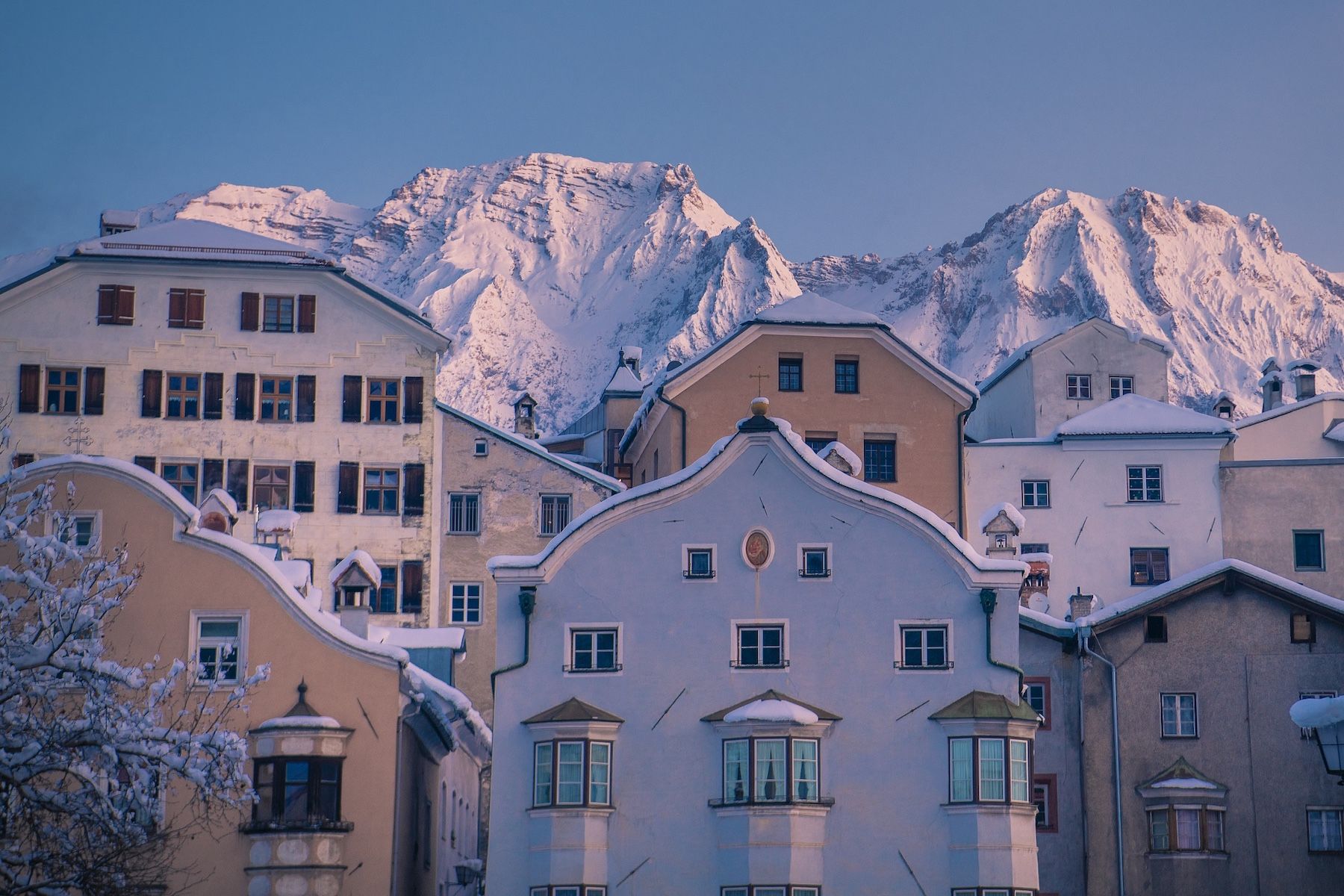
The rose baroque façade of the Kontor Boutiquehotel on the Unterer Stadtplatz in Hall in Tirol.

The Counting House

The Barocker Saal breakfast room at the Kontor Boutiquehotel, beneath its restored eighteenth-century stucco ceiling.
Built into the original Medieval town walls of Hall, this former guilders’ house of traditional Tirol style has stood here for well over half a century with records dating back to 1450. Today, behind the rose petal façade, lies the small Kontor Boutiquehotel.

Intro

Hall was built on salt and grew rich on money, and the house at Unterer Stadtplatz 7a is where both were counted. A kontor is a counting house, the room where a merchant kept his ledgers, weighed his goods and closed his deals, and this one had records against its name by 1450, when Hall was the busiest trading town on the upper Inn and the archduke's mint was about to arrive and make it richer still. The façade gives a soft baroque rose to the lower square, calmer now than the fortunes it once represented. Behind it sits a boutique hotel of eight rooms and suites, open since December 2018, and the pleasure of the place is that almost nothing in it is new. Paint, wallpaper and plaster came off by hand across years of patient work, and what emerged from beneath is what guests now live in: a gothic spiral staircase winding around a bare patch of stone, beamed ceilings gone the colour of dark treacle, eighteenth-century stucco running the length of the breakfast room, and inlays of ebony, a wood once traded by weight against gold. This is a protected building that has been returned to use, and it wears its centuries openly, in the tilt of a floor, the depth of a wall, the iron handle on a door that has been opened for five hundred years.

Everything Came Off by Hand

The glass panorama lift at the Kontor Boutiquehotel, cut through the historic ceiling construction of the house.

The restoration was slow because it had to be. Layer by layer, the additions of the twentieth century were taken back, and each removal was a question about what lay underneath: gothic below baroque, stone below plaster, the original boards below the varnish. Nothing was straightened, nothing was made to match. Where a wall wanted to stay raw it was left original, and the spiral staircase now turns around an exposed patch of masonry so that anyone climbing it can read the fabric of the house directly. The contemporary layer sits lightly on top and knows its place. Lime-washed walls, waxed parquet, bespoke carpentry cut from the building's own salvaged boards, and a palette of clock-face white, cardinal red, cotton grey, wet putty and oatmeal. Modern light fittings hang beneath original stucco without apology. The single boldest move is a glass lift, dropped through the middle of the house so that the ride between floors becomes a cross-section of it, historic ceiling construction passing the glass on the way up. It is a museum-free approach to a museum-grade building, and it works because the house is being used again for what it was built for: people arriving, doing business, staying the night.

Gothic, Baroque and One Romanesque Wall

Two canvas butterfly chairs and a black side table at the Kontor Boutiquehotel, seen through an open door beneath a heavy dark beamed ceiling, raw lime plaster walls and an arched window in pale linen curtains. A black desk built into the window reveal of a guest room at the Kontor Boutiquehotel, Hall in Tirol, with a dark moulded shell chair, task lamp and books, below a moulded plaster cornice on wide antique pine boards.

Eight rooms and suites, and no two share a century. The named categories read as a short course in Tyrolean building history. Gotik takes its character from a massive beamed ceiling, with the desk and open wardrobe made up from old boards lifted out of the house itself and the bathroom set at an angle to the room. Twinset separates living from sleeping and puts a seat in the oriel window, which is the best place in the hotel to watch the square. Barock has the floor and the stucco to justify its name. Nostalgie keeps its historic plasterwork, a secretive old door and a custom trunk chest built for the space. Suite Süd is the largest, holding a romanesque stone wall, a gothic beamed ceiling and a freestanding bath, and it is the one to ask for. Throughout, floors are refurbished timber, warm underfoot and made for going barefoot, and the modern intrusions are deliberate and few: floor-to-ceiling mirrors, mid-century seating, sharp new bathrooms. Each room carries a safe, a Nespresso machine and a kettle, and a minibar worth investigating for the Latschenlikör, a Tyrolean liqueur pressed from the cones of the mountain pine.

No Music at Breakfast

The open breakfast cupboard at the Kontor Boutiquehotel, its white panelled doors folded back on shelves of glazed ceramic cups, glass jars and a steel coffee urn, beneath the baroque stucco ceiling of the Barocker Saal. The Barocker Saal breakfast room at the Kontor Boutiquehotel, morning light across wide pine floorboards, timber tables and moulded shell chairs in sage, white and rust under an eighteenth-century stucco ceiling.

Breakfast happens in the Barocker Saal beneath a restored stucco ceiling from the eighteenth century, on the original floor, and the room is kept deliberately silent of music so that guests talk to one another instead. It is a small decision that tells you most of what you need to know about the house. The buffet is short and regional and gets better the closer you look at it: ham and speck from butchers in Hall, coffee roasted by Unbound in nearby Wattens, honey bought directly from a farmer over the border in South Tyrol, and jams made in the hotel kitchen. Ursula cooks eggs to order at the side of it, and the omelette is her speciality. Breakfast is included in every rate, which in a house this size means somebody has been up early on your behalf.

A Weakness for Old Houses

Ursula was born in Hall and grew up inside its old town, then spent years away in Corsica with the idea of running a chambres d'hôtes among the island's half-ruined stone houses. That plan came home with her. When the former trading house on the Unterer Stadtplatz stood empty and unloved, its render crumbling and its rooms full of dust, she recognised what it was and took it on, and the years of scraping, sorting and rebuilding that followed produced the hotel that stands here now. She is the reason the place is warm as well as beautiful, and guests notice her long before they notice the stucco.

The Town That Minted the Dollar

Hall in Tirol holds the largest intact old town in western Austria, bigger than the one in Innsbruck, which is why Tyroleans call it their secret capital. The wealth came out of the mountain: brine from the Halltal above Absam, piped down to the pans from 1272, exported as far as the Rhine, and still on the town's coat of arms in the form of two lions holding a barrel of salt. The mint moved here from Meran in 1477, and in 1486 the presses inside Burg Hasegg struck the Guldengroschen, the first large silver coin in Europe. It became known as the Thaler, and from the Thaler came the dollar. The castle and its Münzerturm stand three hundred metres from the hotel door, with the mint museum inside and kestrels nesting in the tower. Around them run cobbled lanes, painted merchant houses, church towers and convent walls, a Saturday farmers' market on the upper square and one of the better Christmas markets in the Tyrol. Beyond the town the Karwendel nature park rises to the north and the Glungezer to the south, both walkable and skiable from the valley floor, and the Swarovski Kristallwelten sit a few kilometres east at Wattens. Innsbruck is fifteen minutes away by train, and trains run every quarter of an hour.

editors PICK


Arthotel Blaue Gans, Austria | Art Hotels in Salzburg Arthotel Blaue Gans, Austria | Art Hotels in Salzburg
ARTHOTEL - Salzburg, Austria

Blaue Gans


A cradle of the arts and style where twisted beams and heritage-thick walls flank a contemporary curatorial scene at this historic coaching inn and foodie haunt since 1350.

read more
Vocabolo Moscatelli | Design Hotel in Calzolaro, Umbria, Italy | The Aficionados Vocabolo Moscatelli | Design Hotel in Calzolaro, Umbria, Italy | The Aficionados
HOTEL - Umbria, Italy

Vocabolo Moscatelli


Restored within a former monastery, this fabulous design hotel and foodie hotspot brings together the stone mason, blacksmith and wood worker with the artisan makers.

read more
Monastero Arx Vivendi Hotel | Garden Spa walled gardens | Architects: noa* | Lake Garda, Arco Trentino, Italy | The Aficionados Monastero Arx Vivendi Hotel | Garden Spa walled gardens | Architects: noa* | Lake Garda, Arco Trentino, Italy | The Aficionados
HOTEL - Arco, Italy

Monastero Arx Vivendi


Once the home of devout Sisters, its aged cloistral heritage has been recast following an exacting narrative of preservation, reframing the monastic aesthetics for the modern nomad without corrupting the patina of austere beauty and timeworn touchpoints.

read more
Aerli Apartments Tirol | Boutique Holiday Home close to the Zugspitze in Ehrwald, Austria, Europe. Aerli Apartments Tirol | Boutique Holiday Home close to the Zugspitze in Ehrwald, Austria, Europe.
APARTMENT - Ehrwald, Austria

Haus Aerli


A contemporary private den for discerning design purists, Ʌerli’s allure is a harmonious marriage of tradition meets modernity, continuing and furthering the strong architectural alpine remit of Tyrolean design.

read more

RELATED


view more