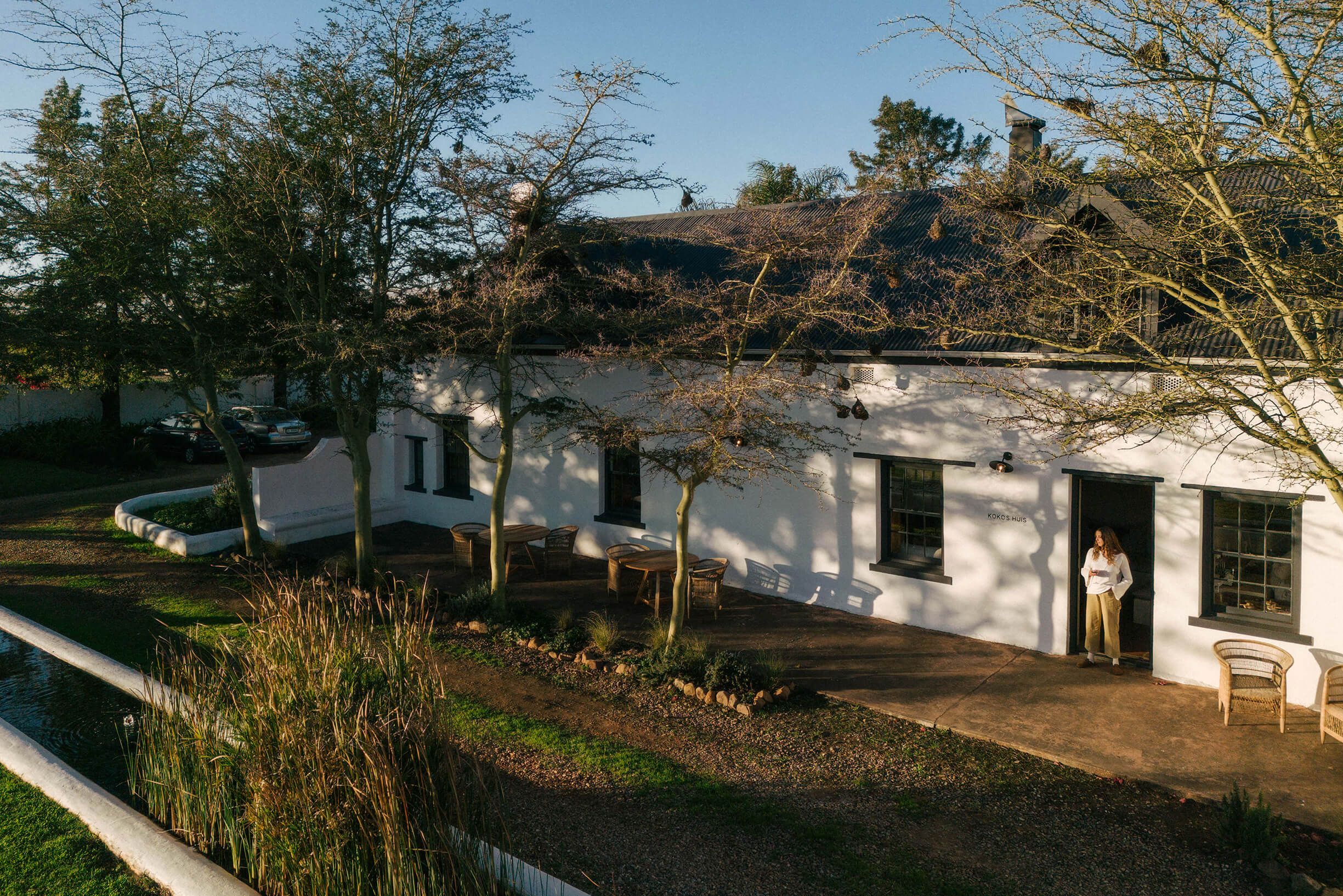
The lime-washed facade of Kokos Huis in late afternoon light, thorn trees hung with weaver nests along the stoep beneath a dark corrugated roof, a woman standing in the open doorway.

Cape Gorgeous

The lounge at Kokos Huis by firelight, an open black steel fireplace beside a built-in plaster banquette in linen and rust cushions, raffia sconces on buff plaster and a blue-grey panelled door.
A gorgeously plain Cape farm building at the edge of Riebeek Kasteel, holding terracotta, raffia and pigment, nine keys, a palm-shaded pool and the Swartland's closed cellars.

Intro

Hidden within a simple Cape farmstead building, Kokos Huis is a rare find: a small, comfy, refined guesthouse that lies low and long at the edge of Riebeek Kasteel, one of South Africa's oldest villages, set beneath the Kasteelberg in a valley of wheat, olive groves, and vineyards. Lime-washed white, its walls built thick enough to keep the Swartland heat on the other side of them. Large palms narrate the gardens, whilst native thorn trees crowd the stoep with weaver nests swinging from their branches, and the name is lettered beside the open door at a size you could walk past. For around two hundred years, this has been a working farm building in the Riebeek Valley, and the gravel pathways give away almost nothing about the fabulous interior design. Inside, the house speaks a different language entirely. Terracotta runs warm underfoot, old, waxed, and faintly uneven. Plaster holds the light in a soft buff, brush-marked so the whole wall moves as the lamps come on. Beams sit heavy overhead, cushions in rust and tobacco pile along a bench built out of the wall itself, and raffia shades throw patterned shadow across the room. Huis is Afrikaans for house, and the word is doing honest work here, on an interior built almost entirely by Swartland hands. Six bedrooms sit under the old roof of the manor house, and three studios stand in the grounds, with palms, a heated pool and a cabana between them. It works as a guesthouse, room by room, and it can also be taken whole, all nine keys and every communal room, by one family or one gathering. An hour from Cape Town, and one introduction to everything the valley keeps to itself.

The Floors were already there

A sitting room at Kokos Huis in daylight, dark timber beams over a boarded ceiling, a linen sofa with a rust throw on old terracotta tiles, a blue-grey door open to the garden.

Prisca Llagostera found the property rustic, neglected and around two centuries old, and her instinct was to let the building say what it wanted to say. The wooden doors stayed. The beams were kept and the shutters left original, their old strap hinges still turning, so the oldest things in the house are also the plainest. She has done this once before, in the Pyrenees, where she kept the dark wood and stone at her Andorran lodge, and the method carries across eight thousand miles without a wobble. Respect the structure, then build inside it.

What she added obeys the same discipline. Seating is formed in plaster and grows straight out of the wall, in the lounge beside the open fire, along the cabana under its reed roof, and in one bedroom where a stepped hearth rises as a sculpted mass with niches cut into it. Furniture and building are one substance, and the richness is carried in the grain of a live-edge slab, the weight of a linen cushion and the cool of hand-trowelled lime.

Almost everything here was made within reach of the house. The restoration was carried out by local craftspeople and the furnishing followed the same rule: the beds built here, the linen and the Mungo towels woven in South Africa, the ceramics thrown at Ceramic Matters, whose studio stands on the Kalmoesfontein farm over in the Paardeberg on the same ground as one of the region's finest cellars. The olives are from the valley and the wines are Swartland only.

Woven fibre carries the house. Raffia and grass appear as wall sconces, as shaggy pendants over the sofas, as a black crescent fan hung above the cocktail room, as beehive lanterns fringed like a hem in the cabana, and as jute underfoot, with two Malawi cane chairs holding the stoep. This is African craft worked at scale and hung with confidence. What Prisca brought to it is memory. She has lived across Latin America and grew up between Andorra and England, and she names her own sources without embarrassment: rawness from Chile, pattern from Mexico, colour and palms from Brazil, natural materials from her Mediterranean side, warmth from her English one. Those references, translated into local hands, have made a house that could not exist anywhere else, a hallmark of Prisca's intuitive design.

Heritage Sleeps Modern

A bedroom at Kokos Huis under a split reed ceiling, morning light through an original pine shutter falling across a rust bedspread and a patterned wool throw, a brass sconce above the linen headboard.

Three bedrooms open straight onto the stoep and the pool, and three sit upstairs beneath the roofline, no two alike. The Old Farm Room has a wood-burning fireplace and antique cupboards; the Corner Room runs on ceiling fans and an earthy calm; the Little Room closes its wooden shutters on the world. Above them, the Room with Lots of Light takes the sun through a sloping attic window, the Cosy Room looks out at the Kasteelberg, and the Family Room adds a small sitting area and a bath.

Upstairs, walls turn a warm putty plaster beneath a boarded ceiling that follows the roofpitch, and wide timber planks replace the terracotta below. Every fitting is brushed brass and unlacquered, held to one finish across the basin taps, the rain showers and the small conical sconces flanking each bed. Beds are dressed in organic cotton and linen headboards, and the bathrooms are stocked with The Scent, blended locally like almost everything else in the house.

Sitting in the two-hundred-year-old farmyard, three studios stand a few metres from the manor house and speak a different language on purpose. Here the plaster is whitewashed, the floors are polished concrete, the window frames are slim black steel and the ceilings are split reed laid over dark beams in the old Cape manner. Each has a kitchenette and a private terrace, and one opens onto a white plastered courtyard with a built-in braai, a bench running the length of the wall and a timber slab table under a pergola. The welcome basket is local and generous: Monarch coffee, whole milk, cultured butter, farm eggs, sourdough and a bottle of Swartland wine. The communal rooms of the manor house stay open to studio guests who want them, which is the whole point of taking a place with its own front door.

Breakfast is made every morning with croissants driven over from Fifty Five Croissants in Wellington, and the all-day menu sticks to small plates and soups, enjoyed by the pool or beside the fire.

Palms, Pool & Chill

The terracotta cabana at Kokos Huis seen across the pool, a fringed raffia pendant hanging beneath the reed roof above plaster banquettes in striped cushions and carved timber stools.

Prisca looked at several buildings and chose this one for its palms. They stand tall over the garden with their trunks pale and their heads loose, and beneath them the ground is given over entirely to the long afternoon. A heated pool runs dark and still along one edge, a firepit waits in the grass for the blue hour, and under a reed roof carried on terracotta piers the cabana holds a plaster banquette deep in striped cushions, a hurricane lantern on a carved stool and enough shade to see out the hottest part of the day. In a valley of wheat, olives and dry open ground, an oasis in the literal sense is a very good joke, and this one is made in earnest.

The day ends indoors in the cocktail room, low and dark and quietly the best room in the house, where a bamboo console carries cut-glass decanters, two carved palms hang on the wall and a pair of fringed raffia pendants throw the space into shadow.

Cellars With No Sign on the Gate

A winemaker drawing wine from a barrel with a glass thief for guests holding glasses in a Swartland cellar. Guests tasting from the barrel with a winemaker in a Swartland cellar, alongside a bottle of A.A. Badenhorst Kalmoesfontein White Blend on a timber ledge.

The Swartland has around thirty wineries and most arrived in the past twenty years. There are no grand tasting rooms out here and very little signage, and the way in is to know somebody. Prisca is married to Jurgen Gouws of Intellego Wines, one of the region's leading natural winemakers, and the house turns that into its finest offer.

On request, she will take guests over the ridge into the Paardeberg to sit in cellars that do not open to the public, among them Adi Badenhorst at Kalmoesfontein and Eben Sadie of Sadie Family Wines. Thursday is pizza night at Kalmoesfontein, and in the middle of harvest two hundred people turn up for it. Best of all is the 5am Wine Club, a sunrise braai in the vineyard with the winemakers, wine for breakfast and a boerewors roll, after which you are welcome to go back to bed. These growers share cellars, lend each other hands at harvest and sell each other's bottles at trade shows, and that is the thing that made Prisca fall for the place.

Hotelier since Nine

Prisca Llagostera, founder of Kokos Huis, seated on a carved timber stool in the cabana beneath a fringed raffia pendant, wearing a wide-brimmed hat.

She wanted a hotel from about the age of nine and took a scenic route to getting one. She read International Relations in London, worked for the British Foreign Affairs Ministry in Andorra and at twenty-two joined the Andorran mission to the United Nations in New York. Then she left it, taught skiing across Andorra, Argentina and Chile, and ran a small ice hotel that had to be built the moment snow fell and melted away every spring. She calls it her apprenticeship, and it shows. In 2018 she opened L'Ovella Negra in the Pyrenees, her sibling property and still her first love. Later that year a friend's wedding brought her to Cape Town, where she met a winemaker and assumed it was a holiday romance until he arrived at her door in Andorra the following week.

Under the Kasteelberg

Kokos Huis sits on Kloof Street, a little out from the centre of the village and screened by its own gardens. The town is a seven-minute walk for lunch at The Barn and about eighteen for a gin under the longest stoep in South Africa at the Royal Hotel. For dinner a village of under three thousand people fields a French brasserie in Au Bouchon Rouge, oysters and a serious wine list included, and the inventive small plates of JAM 1937 around the corner. Kloovenburg, growing wine and olives here since 1704, is five minutes by car, and Allesverloren, granted the same year and in the Malan family since 1872, sits a little further toward Riebeek West. This is old Shiraz country on iron-rich shale, which makes the young growers half an hour south in the Paardeberg the most enjoyable argument you can have with your own doorstep. Ninety minutes northwest, Wolfgat sits above the beach at Paternoster with twenty seats and a foraged menu that won the first World Restaurant Awards, and is worth building a day around.

editors PICK


 Beautiful Boutique Villas, Apartments, Private Houses & Small Hotels
EDIT

Go Private


A fantastic collection of private-hire holiday houses, small hotels and luxury villas for vacation rentals or simply retreats of ‘private isolation’.

read more
Mezi Plutky Boutique Hotel in the Carpathian Mountain range of Beskydy offers cool design accommodation in the Moravian-Silesian region of the Czech Republic Mezi Plutky Boutique Hotel in the Carpathian Mountain range of Beskydy offers cool design accommodation in the Moravian-Silesian region of the Czech Republic
HOTEL - Beskydy, Czechia

Mezi Plutky


Set against the forested Beskydy (Beskids) range in the Carpathian Mountains, this 200-year-old designer hideaway fosters modern Czech country living whilst giving heritage a hug, decked in whites, linens and twisted rafters.

read more
Lime-rendered facade of Masseria Moroseta caught pink in the dusk light, its arched Crittall window framed by olive trees and prickly pear, near Ostuni, Puglia | The Aficionados. Lime-rendered facade of Masseria Moroseta caught pink in the dusk light, its arched Crittall window framed by olive trees and prickly pear, near Ostuni, Puglia | The Aficionados.
Hotel - Puglia, Italy

Masseria Moroseta


A canvas of limewashed walls set against noir and raw stone, hand-thrown ceramics, olive trees and the shifting hues of a working organic grove of 5 hectares, the Adriatic opening out beyond: this is the scene Masseria Moroseta sets, sitting humbly on a soft ridge above Ostuni, the white citadel of Puglia.

read more
JOURNAL

Nine Small Swiss Hotels and Guesthouses Worth the Detour


Nine small, design-led Swiss hotels and guesthouses, from a Nouveau house in the Engadin to Brücke 49 in Vals and a raw chalet above Kandersteg.

read more

RELATED


view more