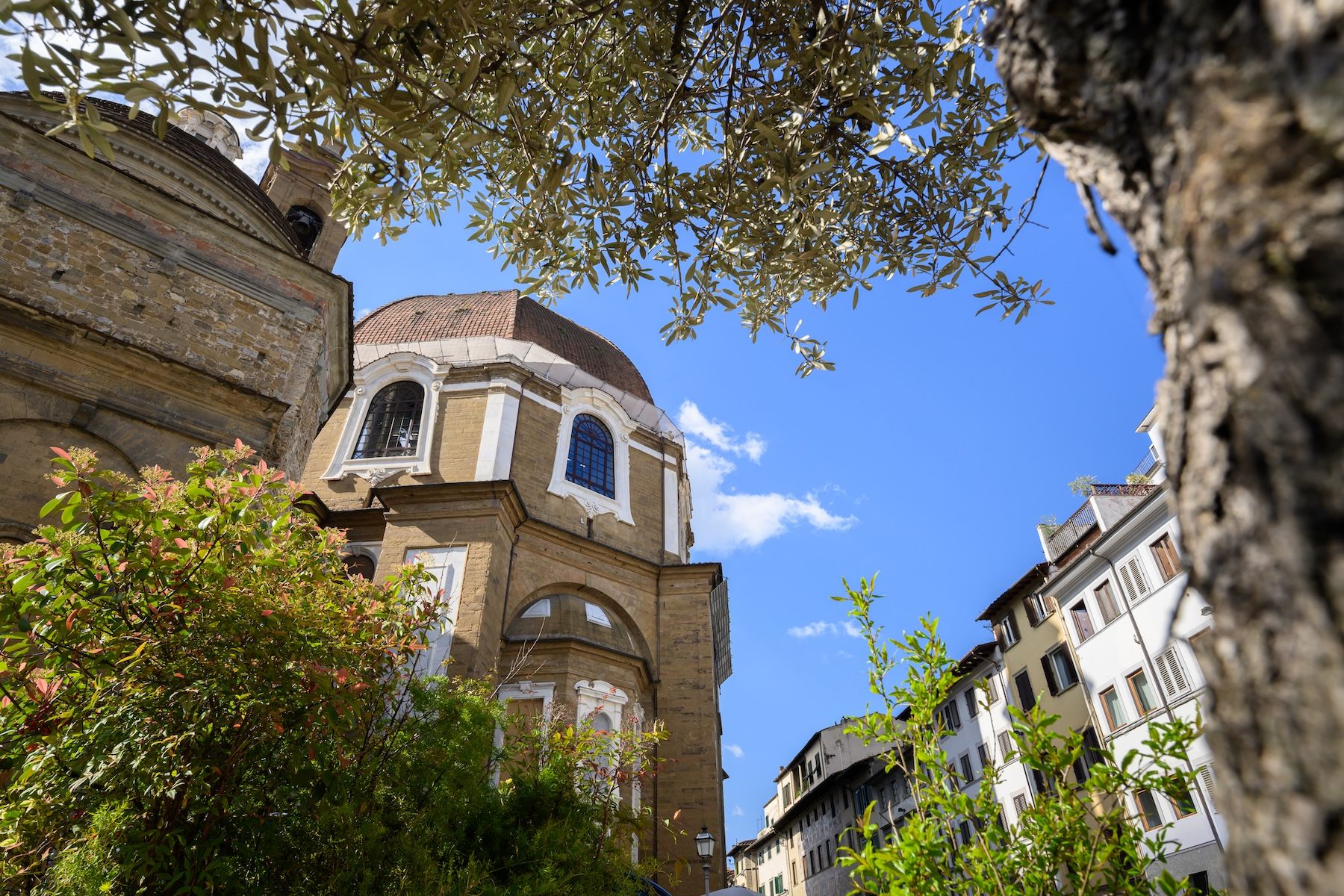
The dome of the Medici Chapels seen through olive branches from Piazza di Madonna degli Aldobrandini, beside Medici Historical Home, images © Tommaso Pini

Under the Paint

Intro

Medici Historical Home is heritage with a contemporary nod. It fills the first floor of a nineteenth-century building on Piazza di Madonna degli Aldobrandini, a small square behind the Basilica of San Lorenzo and beside the entrance to the Medici Chapels, named for Giovanna degli Aldobrandini, born an Altoviti, wife of the merchant Benci in the middle of the fourteenth century. The first thing to register is the height of the ceilings. They rise high over every room, lending the apartment an air of grandeur and space, and they are painted: grisaille ornament, framed panels, fret bands and rosettes, concealed under later coats until a restoration completed in March 2026 brought them back into view. Below them, the interiors navigate towards a smooth remit of pastels, framing the heritage walls: old rose, powder blue, warm greige and Carrara white, touched with brass. The result is a warming palette of sweet heritage, with a feline feel to it. Two suites and a long living room over the square, 130 square metres in all, lie a few minutes on foot from the Duomo, the Mercato Centrale and Michelangelo's New Sacristy.

A Square with a Papal Neighbour

Stone flank of the Medici Chapels framed by an open window at Medici Historical Home, interior lights reflected in the glass, images © Tommaso Pini

The square was once called Campo Corbolini. Its present name belongs to the Aldobrandini, whose Florentine houses stood here from the fourteenth century, and whose collateral branch joined them, over the late seventeenth and early eighteenth centuries, into the palazzo on the corner known as Palazzo Aldobrandini del Papa. Pope Clement VIII, born Ippolito Aldobrandini, is believed to have stayed there on his visits to Florence. The apartment occupies a separate, later building on the same square.

The other neighbour gives the apartment its name. From the living-room windows the view runs straight across to the stone flank of the Medici Chapels, and inside them are the New Sacristy, designed by Michelangelo with his reclining figures of Dawn, Dusk, Day and Night, and the Chapel of the Princes, its walls inlaid with coloured marble and semi-precious stone. On the far side of the square, a house still wears a painted facade of faded figures and medallions, so painted surfaces meet the eye inside and out.

Conservation Pastels

Restored grisaille ceiling with fret bands and a rosette above a bronze ring of spotlights, Medici Historical Home, images © Tommaso Pini

The ceilings have been conserved as they were found, worn and soft where the old paint gave way, and nothing new touches them. The modern work stays below instead, with a quintessential contemporary nod: mirrored panels on the cabinetry and along the tops of the walls catch the ceilings and return them to the room, so the decoration is seen twice. The walls are a warm greige patina, and each room takes its colour from the restored decoration above it.

The furnishing spans two centuries. A walnut scroll-arm sofa on sabre legs, Biedermeier in feeling and dressed in cream, faces a pair of 1950s Italian armchairs in grey bouclé across a hexagonal table of brass, chrome and glass, on a rug of mustard and olive wool. Lit niches lined in old rose hold red-bound books, etchings and photographs. At the dining end, an oval Carrara table on a white pedestal is set with red candles in silver candelabra, the one hot note in the room. The kitchen is the most contemporary corner: handleless joinery in matt chocolate brown, Carrara on the worktops and splashback, a brass gooseneck tap, and an island clad entirely in Carrara slabs that doubles as a bar for crystal decanters. Oak parquet runs throughout, set in a chevron in the living room and in herringbone in the bedrooms.

Aged Rose & Powder Blues

Suite 1 at Medici Historical Home: powder-blue bedcover, brass-framed wardrobe wall and a window onto a painted facade across the square, images © Tommaso Pini

Suite 1 looks over the square and is the cooler of the two: a powder-blue panelled wall behind the bed, ruled with fine brass lines, and an upholstered bench on turned legs and brass castors at the foot of the bed. Its bathroom sets brass taps into the wall against grey-veined white marble, with a brass towel rail turned to look like bamboo. Suite 2 is the larger, the sunnier and the warmer. Faded rose garlands run around its painted cove, and the dressing area is lined in old rose and lit from the shelves, with a pull-out bed for a third guest concealed there; the beds join as a double or separate as twins. A mid-century walnut writing desk stands by the tall, linen-hung window, and the bathroom, in beige stone and brass, looks out to the Medici Chapels. Double glazing against street noise, air conditioning and deep 24-centimetre mattresses come with both.

A Creed of Recovery

Florence Luxury Home founders Gianni and Donatella images © Tommaso Pini

Bringing back what earlier owners covered over is something of a working creed for Gianni and Donatella. Their family-run company, Florence Luxury Home, holds that worn surfaces and inherited objects carry more character than anything bought new, and that old materials can usually be put back to work. Antiques and pieces from the family's own rooms sit beside the new brass and parquet, so the apartment carries the settled look of a house lived in for generations, from the week it opened.

Market Halls & Medici Monuments

San Lorenzo is the Medici parish. Brunelleschi's basilica was the family church, and Michelangelo's Laurentian Library sits within its cloister. Palazzo Medici Riccardi, the family's town house, stands two streets away on Via Cavour. The quarter also feeds the city: the Mercato Centrale, a nineteenth-century hall of iron and glass, sells meat, cheese, oil and produce on the ground floor, with food counters above. The Duomo lies just south and Santa Maria Novella station close by to the west, which makes this the most practical base in the collection for day trips by train.

editors PICK


RELATED


view more