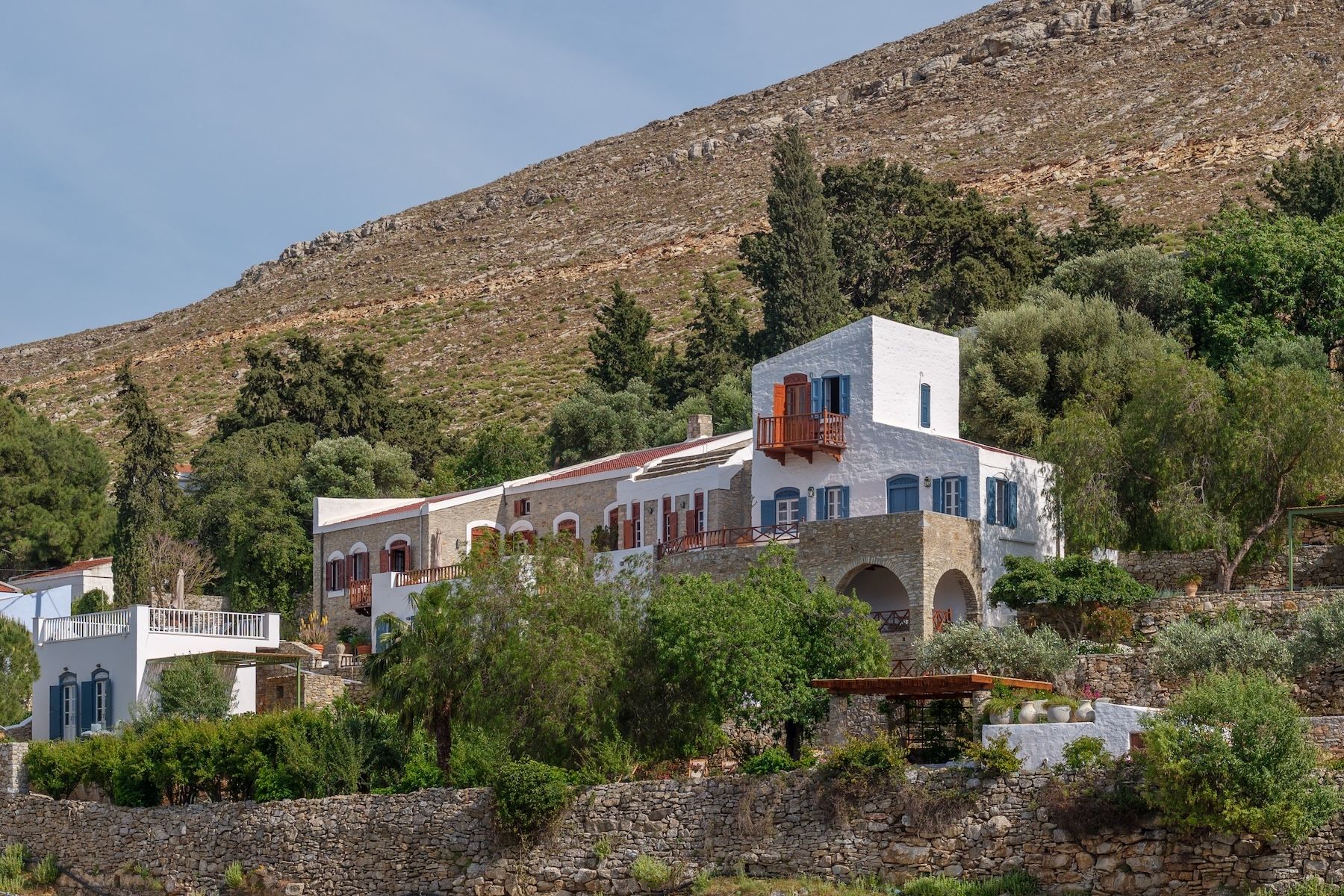
The Selene on Nimborio Bay, Symi: a whitewashed tower with blue shutters beside a stone wing, above a dry-stone sea wall and bare mountainside.|Photo ©️ Will Slater

The Captain's Moon

An arched window with carved fretwork fanlights opens onto Nimborio Bay at The Selene, Symi, a cushioned window seat below.|Photo ©️ Will Slater

Intro

On the Greek island of Symi, the same simple, irresistible views have been framed by island architecture for centuries. Today they belong to The Selene, a string of sibling cottages that reads as a small village of its own, raised above a long dry-stone sea wall and the shore path of Nimborio Bay, where, by island tradition, Nireus, king of Syme, set sail for Troy. A whitewashed tower with blue shutters stands sentinel beside a long wing of honey-coloured stone, its arched windows picked out in white, crowned with carved timber fanlights and closed with rust-red shutters. Below, a lower storey of blue-shuttered doors and windows gives way to a stone arcade that carries the terrace, reached by an open timber staircase. Whitewash, blue and stone sit in near symmetry, giving the house a face that is its own and still familiar to the soul of the Dodecanese. Cypress and twisted olive climb behind it to the bare mountainside, and stone terraces step down to the water's edge, their gardens and doorways opening straight onto the Aegean.

The Selene is a five-suite private house on a quiet fishing bay along the north coast of this mountainous Dodecanese island, about three kilometres around the shore from the harbour at Gialos and within sight of the Turkish coast. It is taken whole as a buyout villa for up to fourteen guests, or by the suite in the gentler months. Built in local stone in the manner of the island's old merchant and captains' houses, it is furnished with a collector's eye: reclaimed iron beds, painted dowry chests from northern Greece, handmade brass lights by Athenian and Symiot artisans. The interiors draw on Greek heritage with a sleight of hand.

The house began with its first owner, Selina, whose determination and imagination gathered a scatter of cottages, terraces and gardens above the bay into one remarkable whole, known for years as Emporio Symi. In 2020 it passed to Annette Thomas, who renamed it The Selene, for Selina and for the Greek goddess of the moon, and chose to carry the story on. Brand Frank shaped the identity around the new name, from tone and positioning to the creative, and helped Annette steer the commercial model. Her restoration has been guided by restraint: older pieces stay where they have always stood, and new ones look as though they have been there just as long. She sees herself as the house's next custodian, there to look after it and add another quiet chapter.

Iron, Brass and the Painted Dowry Chest

Twin iron beds either side of a painted dowry chest at The Selene, Symi, with brass sconces, botanical prints and a floral rug.|Photo ©️ Will Slater

The interiors draw on the island's own building customs. Gialos's merchant houses, built on sponge and shipbuilding wealth through the nineteenth century, kept their finest rooms upstairs under tall, painted ceilings, with decorated door and window frames and tiled roofs above. The Selene follows suit. Ceilings are boarded and painted, pale blue between white beams, and doors are panelled in timber, some stained dark, others painted a soft island blue. Pierced fretwork fanlights crown the arched windows, and deep window seats look out through double casements to the bay. The living room rises to a full double height, with a white-panelled gallery screened with lattice and a wicker dome lamp suspended in the space between. Below sit white sofas, rush-seated chairs, a table made from reclaimed planks on a red kilim, and a gilt mirror above a painted chest.

Painted dowry chests, the kind once packed with a bride's linens, recur throughout the house. One is crowded with red and pink blooms on an ochre ground; another, dark green with an urn of flowers held in a wreath, serves as a bedside table between two iron beds in a room lined with white tongue-and-groove, brass sconces, botanical prints of crocus and cyclamen, and a floral rug in blue and yellow. In Thalassa, a red-painted iron four-poster with brass finials stands beneath a brass chandelier, beside a striped armchair stitched with the house's crescent moon and blue doors opening onto the terrace. Brass lighting and furniture by craftspeople in Athens and on Symi share space with pieces that predate the restoration. Annette shaped the interiors with Dan Rentillo, a close friend and former wedding-dress designer for Vera Wang, who brought a couturier's eye for line and detail to every room. The rooms feel assembled over years by people who kept what they loved. Practical care is just as considered: a new stone staircase now runs from the house down to the beach, a desalination system supplies filtered drinking water so plastic bottles never arrive, and solar power is the next project.

Soil, Amphorae and the Artist Gardener

Terraced gardens by Dimitri Launder, at The Selene, Symi: curving dry-stone walls, pale stone paths and drought-resistant planting above Nimborio Bay. |Photo ©️ Will Slater

Dimitri Launder, a Hellenic British artist and gardener whose maternal family comes from Symi, created the gardens. Known as the Artist Gardener, he has spent twenty-five years creating socially engaged work on regenerative ecology for Tate Modern, CCA Glasgow, Arts Catalyst, Estuary Festival, and the RHS Hampton Court Flower Show. At The Selene, he set out to celebrate the soil as the garden's soul. Fragrant, drought-resistant planting fills the terraces, and cool dappled shade gathers against the old dry-stone walls. Beneath it runs a system he calls Amphora Composting, his adaptation of archaic methods: terracotta amphorae set into the beds as wormeries, their indigo lids answering the sea and sky of Nimborio. Pale stone paths run between drifts of white daisies, and under a pine a sage-green bench gathers cushions beneath three pierced brass lanterns hung from the branches.

Launder's reasons go beyond this one garden. Symi has thousands of ancient terraces, and as they fall out of use their soil washes down into the sea. There it feeds the seagrass meadows around the island, which store carbon faster than most forests. He sees soil as central to rural life on an island like Symi, and The Selene's garden is where he is putting that into practice.

Five Suites Named for Sea, Earth and Sky

A red-painted iron four-poster under a pale blue beamed ceiling at The Selene, Symi, blue panelled doors open to the terrace.

Each of the five en-suite suites carries a Greek name. Eos, the dawn, has a super king bed, a private terrace and a sea view that catches the first light. Gaia, the earth, is the family suite, with a vintage iron bedframe, two singles, sea views and that painted dowry chest. Thalassa, the sea, pairs a super king iron canopy bed with a second twin room, terrace doors opening to the water, an oval table and a separate WC. Nykta, the night, is reached by an internal staircase and features a vintage iron headboard and its own generous terrace. Selini, the moon and the most spacious of the five, has a raised platform bed in the manner of the sofas, the timber sleeping platform of the old Dodecanese house, a settee, a writing desk, a private balcony and a back terrace. The living room, with its own entrance from the terrace, can take two more on sofa beds when needed.

Long Lunches and Morning Swims

A long lunch table under a reed-roofed pergola at The Selene, Symi, laid with striped linen and wirework chairs, the bay beyond.

A small team who live on the island, Claire, Louli and Dimitris, look after the house and its guests with the ease of neighbours, and many people leave as fond of them as of the place. Breakfast is built on local produce. Dimitris cooks a long Greek lunch around whatever came off the boats or from the market that morning, eaten slowly at a long table under the trees. It is laid with green-striped linen, sage ceramics, woven placemats and marble wine coolers, with wirework chairs in blue and green and a brass lantern hanging overhead. A private chef can be arranged, or guests bring their own. The terraces work as outdoor rooms: whitewashed parapets, built-in benches piled with striped cushions in sea blue and olive, terracotta tiles underfoot, and the bay laid out beyond, with the waterfront houses of Nimborio, moored boats and the bare hillside rising opposite. Days arrange themselves: paddleboards and snorkels at the foot of the steps, boules on the terrace, films on the outdoor cinema screen after dark, yoga or massage on request, a motorboat for the bays beyond.

The Whole House or a Single Suite

The Selene comes into its own as a whole-house buyout: a holiday rental for a family, a gathering of friends or a small retreat with the place to themselves. In high summer the whole house is usually the only way in. In late spring and early autumn, when Symi is at its best, individual suites can be taken by private enquiry, and a few carefully chosen hosts bring walking, yoga, painting and food retreats, capped at fourteen guests and paced by the rhythms of the house. Harbour transfers are included, and a private motorboat can collect guests from Rhodes.

The Neuroscientist of Nimborio Bay

Annette Thomas, owner of The Selene, seated on a whitewashed terrace wall above Nimborio Bay, Symi.|Photo ©️ Will Slater

Annette Thomas makes an unusual custodian for a Greek island house. A scientist by training, she took an honours degree in biochemistry and biophysics at Harvard and a doctorate in cell biology and neuroscience at Yale, then joined the journal Nature as an editor. Two decades in science publishing followed: founding editor of Nature Cell Biology, managing director of Nature Publishing Group, then chief executive of Macmillan Science and Education, where she oversaw the merger that created Springer Nature and founded the research incubator Digital Science. She later led the Web of Science Group through its listing on the New York Stock Exchange, and in 2020 became chief executive of Guardian Media Group. Today she divides her time between Cambridge and Symi. Greece began as a holiday destination for her and, over more than thirty years, has become part of the rhythm of her life.

Symi, Kept Intact

Symi has no airport and no large resort, and the whole island has been protected as a national monument since 1971. Above the harbour at Gialos, neoclassical mansions rise in tiers, built by the sea captains, shipbuilders and sponge merchants of the nineteenth century. Nimborio was once Symi's ancient harbour, and its name keeps the memory: a softened form of Emborios, from the ancient Greek emporion, a place of trade. Homer has Nireus, king of Syme, sail from this bay to Troy, naming him the handsomest of the Greeks after Achilles, before adding, rather drily, that he brought only three ships and very few men. Most guests arrive by ferry from Rhodes, about fifty minutes, and are met at the harbour in Gialos. Others come straight to the house by sea: a private RIB from Rhodes takes about an hour to the jetty outside The Selene, yachts can deliver guests to the same jetty after a sail of two nights or more, and helicopter transfers can be arranged from other islands. However they arrive, the island sets the pace from the first step ashore.

editors PICK


JOURNAL

Artisan of the present, with the soul of the past


Working from Malasaña, Javier Sánchez Medina creates contemporary objects from natural fibres, guided by esparto grass, inherited craft knowledge and a deep respect for material, process and time.

read more
DENHARTEN | Boutique Design Guesthouse & Event Venue in Bavaria, Germany DENHARTEN | Boutique Design Guesthouse & Event Venue in Bavaria, Germany
Guesthouse - Bavaria, Germany

Denharten


Farmstead aesthetics slip seamlessly into bed with a contemporary cousin at this bucolic commune of guesthouse and creative venue space known collectively as the DENHARTEN.

read more
Design Hotel in Tavira – Hospedaria, A Barefoot Algarve Retreat Design Hotel in Tavira – Hospedaria, A Barefoot Algarve Retreat
Hotel - Tavira, Portugal

Hospedaria


Barefoot brutalism meets citrus calm. Hospedaria is the crash pad for design lovers, where vintage finds, art, and concrete cool rewrite the rules of rural Algarve stays.

read more
Casa Fortunato Alcácer do Sal | Design Hotels of Alentejo, Portugal Casa Fortunato Alcácer do Sal | Design Hotels of Alentejo, Portugal
Guesthouse - Alcácer do Sal, Portugal

Casa Fortunato


Casa Fortunato is where design, history, and soul collide making it a rare private-hire house in Alentejo. Inside, postmodernist pieces beautifully marry with Portuguese heritage, vintage glamour and artistic rebellion.

read more

RELATED


view more