
JOIN the AFICIONADOS
Get the insider news and lowdown on what we've been up to, where we've been, and who we've met along the way. Be the first to discover new places and get the scoop on our favourites.

For more than a century a small workshop in the Aargau village of Hägglingen has turned out hats and, when the times required it, dried potatoes, trouser buttons and raincoats. The history of Risa, told through six things it made.
Few hat makers can claim to have weathered a world war by drying potatoes. Risa Hutwerkstatt can, and that is only the second most improbable entry in its records. Its story, which runs from the straw country of the Freiamt to the stages of Swiss opera, is best told the way a good museum would tell it: one object at a time.


A century ago the Freiamt, in canton Aargau, was known well beyond Switzerland for its straw, plaited and exported far and wide in the form of hats. In 1919, at the height of that trade, Marin Geissmann set up a small factory in Hägglingen to make straw hats for women. From the 1960s the industry around it all but disappeared. The factory, stubbornly, did not.
Ownership passed to Josef Sax and his colleague Martin Richner, whose surnames, trimmed and joined, gave the label its name: RI and SA. During the Second World War, with millinery low on anyone's list of priorities, the pair kept the lights on by drying potatoes, and later fruit. Nobody appears to have kept a sample.
Peace brought a stranger sideline still. Using an old pasta press converted for plastic, the workshop began turning out RIWISA trouser buttons, an episode that tells you plenty about Swiss ingenuity and very little about hats.
As the world went bareheaded, Risa became known for rainwear, and for hats to keep the weather off. Pela Ristic, a seamstress with some thirty years at the firm, recalled the era without ceremony: "Above all, we sewed black rain hats." Uniform caps followed, the St Gallen cap maker La Casquette joined in 2000, and the Swiss Army became a customer.

In 2010 Julian Huber, a trained mechanic from the village and grandson of Josef Sax, took over with his mother, Gaby Huber-Sax, renamed the business Risa Hutwerkstatt and set about bringing it back to life. Some of the machines on the floor are close to a hundred years old, and he keeps them running himself. Shaping is still done by hand with an iron and a damp cloth; blanks arrive from Ecuador, Portugal and the United States; a rabbit-hair felt bowler may be dipped in shellac to hold its line. "The procedure is not new," Huber has said, which is rather the point.

Around 9,000 hats now leave Hägglingen each year: top hats and bowlers, panamas and canotiers, yodelling and hunting hats, and trilbies in quantity, many of them in the Freiamt collection in straw, raffia and ramie. Up to a quarter of production has gone to theatre and opera, the Fête des Vignerons in Vevey among them, and Büne Huber of Patent Ochsner has been known to take the stage in a Risa straw. Risa keeps a shop in Zurich and an atelier on Basel's Spalenberg, which carries on the old Basel milliner Schwarz Modes. A Risa hat, Huber says, can be refreshed as many as five times.
Public tours of the factory take about an hour and a quarter and cost CHF 20. No aperitif is offered; the website helpfully recommends the restaurants of Hägglingen and Dottikon instead. It is hard to imagine a more Swiss conclusion, or a better reason to make the trip.
Discover more at Risa Hutwerkstatt.


Perched high, this reborn majesty presides over the larch-wrapped resort of Zermatt in the Swiss canton of Valais, a design hotel that rekindles the Geist of Golden Age Alpinism.
read more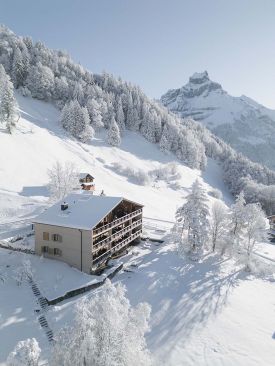
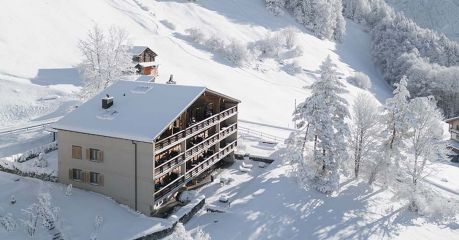
Eye candy sets the tone, a decisively chilled design refuge of honeyed timbers and smooth noir accented interiors, a foodie basecamp and cabin-esque hideout for the lovers of keeping it easy, perched hillside overlooking Engelberg.
read more

Striving for perfection in the field of tobogganing and skiing, Mach ski are wood, aircraft aluminium, fibreglass and a graphite racing base to create a smooth, fast speed.
read more

Made with precision, intelligence and a thoughtful consciousness, Simon Jacomet is on a mission to refine every detail of the ski-making process, with as little waste as possible.
read more

Producing both slalom, race carvers and all-mountain skis, Timbaer skis come in a range of materials, but each benefit from a bamboo core - giving their skis unique flexibility yet sturdiness.
read more

Swiss luxury ski brand ZAI make skis of innovative design, craftsmanship and excellent performance with science underpinning ski design in this high-octane sport.
read more

A fabulously humble basecamp of good design for kindreds of style, Brücke 49 is a collection of rooms, suites, studios and apartments in the high-in-the-mountains creative enclave, Vals.
read more

Unapologetically vivid, this preferred pad of intellect and creativity is awash in Art Nouveau flamboyance tamed with clever 1950s-inspired design interventions. A stylishly cool home of the arts, brushed with boldness.
read more

Since the 14th century, the village of Mund and the UNESCO mountain region has been the quiet spice producer since it was smuggled in via Italy and the Simplon Pass.
read more

Everything in the long-established Ski resort of Zermatt revolves around Switzerland’s icon, the majestic and unmistakable, Matterhorn standing at a hypnotic 4478 m.
read more

For the most festive of Christmas getaways, head to any one of Zurich's many markets, ice-rinks and parades, before settling back in the design den of the city.
read more

How Zurich's ultra luxe-cool stationers Hieronymus epitomise the very Swiss sense of detail + precision.
read more
Get the insider news and lowdown on what we've been up to, where we've been, and who we've met along the way. Be the first to discover new places and get the scoop on our favourites.