JOIN the AFICIONADOS
Get the insider news and lowdown on what we've been up to, where we've been, and who we've met along the way. Be the first to discover new places and get the scoop on our favourites.

Off Greece's far south-eastern edge, the Dodecanese (Δωδεκάνησα) runs in a loose line beside the Turkish coast, from Patmos and Leros in the north to Rhodes, Karpathos and Kasos in the south. The name means "twelve islands", though the group has fifteen main islands, and 26 are inhabited in all. Administratively it belongs to the South Aegean Region (Νότιο Αιγαίο, Notio Aigaio), which it shares with the Cyclades.
The islands differ widely. Rhodes is the largest and busiest, with a walled medieval old town, the clifftop acropolis of Lindos and quieter villages inland. Kos pairs long sandy beaches with the ruins of the Asklepieion. Patmos, in the north, is a pilgrimage island centred on the Monastery of St John. Kalymnos is known for its sponge divers and for sea cliffs used by climbers, Nisyros for its walkable volcanic crater, and Karpathos for mountain villages that keep their own dialect and dress. Smaller islands such as Symi, Tilos, Halki, Lipsi and Kastellorizo suit slower stays.
The architecture records a long succession of rulers: ancient sanctuaries, Byzantine churches, the castles of the Knights of St John, Ottoman mosques and fountains in Rhodes and Kos, and the Italian buildings of the early 20th century, seen most clearly in the planned town of Lakki on Leros. The islands became part of Greece in 1948. Daily life still follows the church calendar: Easter is the biggest celebration of the year, and through summer each village marks its saint's day with a panigyri (πανηγύρι), a night of music, dancing and food served to all comers. Our journal piece on the Dodecanese explores their myths and history in more depth.
The landscape is mostly dry and rocky, scented with thyme and sage, with pine forest on Rhodes and cypress on the higher ground of the smaller islands. Walking routes follow old mule paths between villages, chapels and bays, and spring brings wildflowers across the hillsides. The swimming season runs from late spring into autumn, in pebble coves and sandy bays alike.
Food varies island by island: Symi's small fried shrimp, Kalymnian mermizeli salad, Karpathian makarounes pasta, Rhodian pitaroudia (chickpea fritters), and local honeys and cheeses throughout.
Rhodes and Kos have the main international airports, with smaller ones on Karpathos, Leros, Astypalaia, Kasos and Kastellorizo. Ferries from Piraeus serve the whole chain, and inter-island boats link neighbouring islands through the season.


Perched on the edge of the Caldera, individually crafted houses cling to rock formations, blending whitewashed minimalism, handcrafted detail and a refined boutique aesthetic beyond the typical villa.
read more
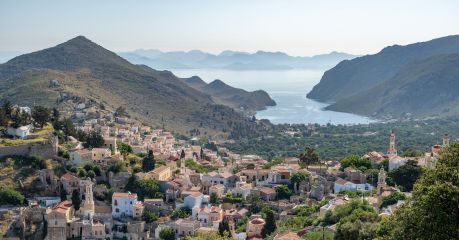
A Dodecanese island north of Rhodes, where a neoclassical harbour town climbs three hillsides, monasteries stand in juniper uplands and boats ferry swimmers to coves.
read more

Plato argued that a beautiful place makes you think better. In the pines above Athens, a discreet club lavishes twenty hectares on proving him right: a world of architecture, sports and holistics.
read more

Ayiopetra is a design-led boutique hotel in Naxos, beside the 6th-century BC Temple of Demeter, blending Cycladic architecture, agricultural heritage and curated interiors into an adults-only retreat.
read more

Housed within a fabulously restored Venetian-styled mansion house, this design hotel with nine suites and a stunning rooftop bar has put the island of Syros back on the map.
read more

Athens. A city of such ancient historical weight, it’s no wonder the capital’s charms lay for centuries in the fascination of its antiquities: the ever-present Acropolis and Parthenon, its agoras and temples and the adjoining museums stuffed with the treasures of Ancient Greece.
read more

Éros Kéros Villas, on the slow-pace Cyclades island of Koufonisia, come drenched in Aegean blue vistas – a sun-kissed boutique retreat of four cubic Cyclades-style merchant houses that lazily gaze onto the island of Keros.
read more

Get lost in ancient myths, stunning coastlines, and vibrant culture. From sun-kissed shores to hidden treasures, dive into an adventure you'll never forget.
read more

Forget the crowds. Tinos doesn’t perform for tourists - it just exists, cool and unshaken, carved from marble, kissed by salt and wind. A Cycladic retreat where time bends, and creativity flows.
read more

A wonderful six-suite design guesthouse-hotel in the creative heartlands of Athens in the Kolonaki Quarter - home to the creative set, bookstores, publishing, galleries, museums and cafes.
read more

A tiny dot in the Cyclades Islands, Syros shimmers in the Aegean Sea, surrounded by a circle of Cycladic isles such as Tinos, Serifos, Mykonos, Paros and Sifnos. Like all island adventures, the best way to arrive in Syros is by via classic Greek, sun-drenched ferry into the ancient town of Hermoupolis/ Ermoupoli.
read more

The Peloponnese is like Greece’s aloof older sister: still and beautiful to look at, but often overlooked in favour of more naughty, fun little islands.
Get the insider news and lowdown on what we've been up to, where we've been, and who we've met along the way. Be the first to discover new places and get the scoop on our favourites.