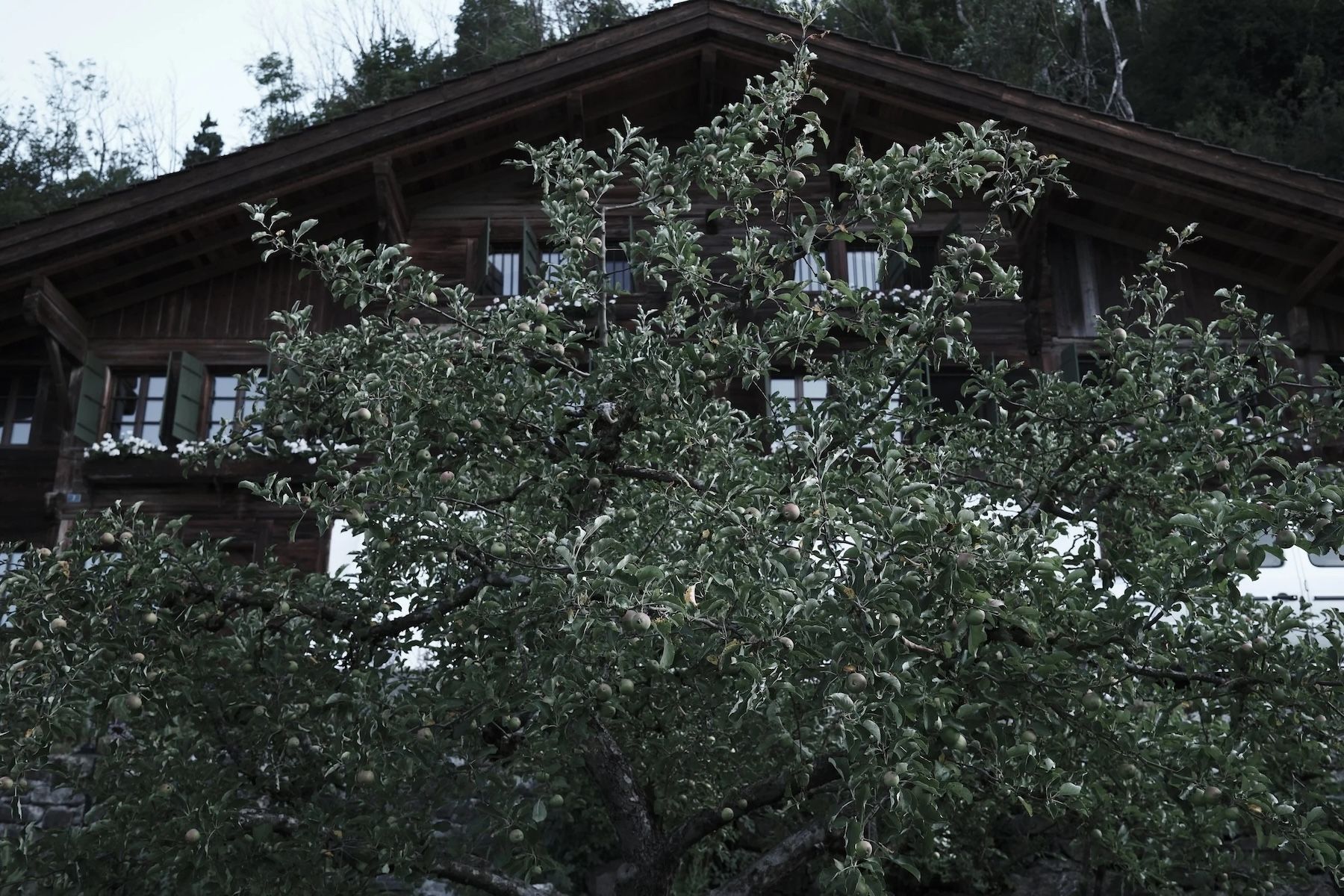
What they found instead was a derelict eighteenth-century chalet, neglected and settling into the slope above Mannried, the kind of building most people would have measured for demolition.

Patient Custodians

A close detail of Haus Mannenberg's weathered, near-black timber corner beams, the deep grain and joinery in sharp focus, while a whitewashed wall, green shutters and white geraniums recede softly behind.

Intro

Some things are best left as you find them. This is the truthful narrative of Haus Mannenberg, a small, considerately curated outpost of contemporary Swiss style, hinged on heritage rather than decoration, above the hamlet of Mannried, just beyond Zweisimmen and minutes from Gstaad. An eighteenth-century chalet turned guesthouse set on more than two thousand square metres of private grounds, it stands sandwiched between the mountains and a dense canopy of pine trees and an apple orchard in the Bernese Oberland. From the lane, it deliberately gives little away. Sultry dark timber, weathered close to black by three centuries of mountain winters, wears the traditional window-and-shutter frame of the region and keeps its own counsel. Cross the threshold, cut deep through walls built thick to hold out the winter, and the compression releases: the plan opens, the ceilings lift into the roof, and the light does the talking, moving across old plaster, bare beams and pressed linen until the rooms turn almost painterly. There is a puritan restraint to it, nothing loud, nothing surplus, its richness carried in the grain of the wood, the weight of the linen and the cool of lime plaster rather than in any ornament. This is the particular pleasure of Haus Mannenberg: a dark, guarded exterior that keeps its warmth for those who come in, and an interior built entirely from texture, detail and the tactile. A working farmstead for most of its life, it is now a four-room guesthouse given over to a slower way of being in the Swiss Alps.

What they found instead was a derelict eighteenth-century chalet, neglected and settling into the slope above Mannried, the kind of building most people would have measured for demolition

Restored, Not Rebuilt

The restoration ran from 2020 to 2023, three years complicated by a pandemic and carried out hand in hand with local craftsmen and the Bernese heritage authorities. The guiding question was never how much could be added, but how little needed to change. Original timber was kept wherever it could be saved. New heating, insulation and services were threaded discreetly behind the historic walls, so the comfort is modern and the character is not. The house still holds its original smoke chamber, once used to preserve food through the long Alpine winters, left in place as a plain reminder of the lives it was built for. Maria and Max moved in as permanent residents in 2023, and only after a further round of work did they open the doors to guests in 2026. The measure they set themselves was simple: will this still feel right in fifty years.

The result is a house made to be lived in rather than looked at. The guest rooms are kept deliberately screen-free, so a separate lounge, set apart from the main living space, gives everyone somewhere to draw together in the evening, for a film, a rainy afternoon, or the slow unwinding that follows a day on the mountain. Outside, the grounds open the chalet to every season: a lawn to read on, a fire pit for the blue hour, a barbecue for long dinners, and a terrace with uninterrupted views across the fields to the peaks beyond.

Four Rooms Under the Roof

An attic bedroom at Haus Mannenberg tucked beneath the sloping timber roofline, a recessed skylight drawing daylight down the raw wood, the bed dressed in crisp white linen with a soft knitted throw folded across it. A quiet work corner in a Haus Mannenberg guest room: a pale oak desk and light wood chair against a timber-plank and grey-plaster wall, a black task lamp and glass water bottles on the desk, and a black-framed portrait photograph above.

Softness plays against the original timber and plaster, milky greys offset the natural hues, and a thread of noir runs beneath. There are four guest rooms, two on the first floor and two tucked beneath the historic roofline, no two the same. The Garden Room is the largest, with soaring timber ceilings, a walk-in wardrobe, a generous en-suite and views into the garden. The Morning Room takes the early sun beneath its old, beamed ceiling, with a private bathroom set opposite the door. Up under the eaves, the Upper Room keeps its exposed beams and a reading chair beneath sweeping mountain views, while the Attic Room is the most intimate of all, its sloping ceilings and roof windows framing the peaks. There are no televisions and no coffee machines here, and that is deliberate. What the rooms offer instead is quiet, Schlossberg linen, Susanne Kaufmann amenities, and the particular hush of a house that has stood still for a very long time. Taken whole, the chalet sleeps up to eight and can be booked in its entirety by a family or a gathering that wants the run of the place.

Slow Mornings

The communal breakfast table at Haus Mannenberg by a run of timber-framed windows, laid with white plates, a floral jug, cut garden flowers and a dark country loaf, morning light falling across the dark wood.

Breakfast begins late on purpose. The house is allowed to wake at its own pace, and so are its guests, gathering around one long communal table where joining the conversation is entirely optional. A newspaper and a second espresso are as welcome as company. The table carries fresh bread from village bakeries, regional cheeses and Swiss yoghurts, homemade preserves and seasonal fruit, hot dishes prepared to order, and speciality coffee alongside a considered selection of teas. Most of it is sourced from producers within reach of the valley. Nobody is hurried on, and many mornings drift well past their natural end, out onto the terrace or into the quiet of the library.

Wellbeing and the Barn

A hand reaching for two Susanne Kaufmann oils, an amber-glass face oil and a clear arnica body oil, resting among green grass and clover in the grounds at Haus Mannenberg.

From September 2026, the house adds two more reasons to linger. In an intimate treatment room, an exclusive regional partnership with the Austrian Alpine skincare house Susanne Kaufmann brings a pair of unhurried rituals: a full-body massage to loosen the mountains out of tired legs and a botanical anti-ageing facial, each taken by reservation. At the entrance to the property, a restored barn becomes a small boutique, curated rather than stocked, filled only with things chosen for craftsmanship and made to last, from Alpine skincare to Swiss wines and considered objects for the home. The rule is the same one that governs the rest of the house: a few good things, done properly.

The Curators

Maria, co-owner of Haus Mannenberg, sitting outside against a whitewashed wall beside a deep-set antique timber door, arms folded, in a blue striped shirt, looking off to one side.

Maria and Max were not looking for a project. After the better part of a decade in England, the couple came back to the Saanenland wanting a modest weekend retreat near the mountains they had grown up beside. What they found instead was a derelict eighteenth-century chalet, neglected and settling into the slope above Mannried, the kind of building most people would have measured for demolition. Maria works in interior design, Max in property development, and between them they saw what the house could be rather than what it had become. They bought it, and the weekend retreat quietly turned into a calling.

Where the Valleys Meet

Mannried sits at a quiet crossroads, where the Simmental, the Saanenland and the French-speaking Pays-d'Enhaut fold into one another. Within half an hour the landscape shifts from the rounded moorland above Sparenmoos to working valley floors, limestone walls and glaciated peaks, stitched together by the Gross and Kleine Simme, the two rivers that meet near Zweisimmen. Gstaad and its polish are minutes away, yet Mannried keeps the plainer rhythm of a farming hamlet. Saanen carries the settled confidence of an old regional capital, while Rougemont and Château-d'Œx mark the point where German timber gives way to French painted masonry. The side valleys of Lenk, Lauenen and Jaun reward anyone willing to go looking. The GoldenPass railway threads the region together, from Montreux over the hills to Interlaken, slipping from one language into the next, and the reward here is for curiosity rather than speed.

The station at Zweisimmen is five minutes away by car, Bern airport about an hour by road, Geneva around two hours, and Gstaad's own airfield at Saanen a quarter of an hour for those arriving by private aircraft. Easy enough to reach, quiet enough that most people only hear of it from someone who has already stayed.

editors PICK


FOLLONICO B&B is a romantic, boutique guesthouse in Montefollonico, Tuscany FOLLONICO B&B is a romantic, boutique guesthouse in Montefollonico, Tuscany
Guesthouse - Tuscany, Italy

Follonico


A restoration den of raw genius – a weathered Tuscan house close to Montefollonico that has been allowed to expose her weathered elements and complemented with chic salvaged interiors. An imaginative retreat of utter, rustic romance.

read more
Gasthaus Reichhalter 1477 Lana, South Tyrol - new design hotel guesthouse Italy Gasthaus Reichhalter 1477 Lana, South Tyrol - new design hotel guesthouse Italy
GUESTHOUSE - Lana, Italy

1477 Reichhalter


Ceramics, pencil-lead greys, putty linens and aged furnishings headline at this restored design guesthouse of original simplicity in the cute market of Lana, South Tyrol.

read more
JOURNAL

Oeschinensee: The Swiss Alpine Escape That Recalibrates the Soul


Lose yourself in the wild beauty of Oeschinensee—where glacial waters shimmer, cliffs rise like giants, and the Swiss Alps whisper secrets only the boldest travellers will hear.

read more
Mezi Plutky Boutique Hotel in the Carpathian Mountain range of Beskydy offers cool design accommodation in the Moravian-Silesian region of the Czech Republic Mezi Plutky Boutique Hotel in the Carpathian Mountain range of Beskydy offers cool design accommodation in the Moravian-Silesian region of the Czech Republic
HOTEL - Beskydy, Czechia

Mezi Plutky


Set against the forested Beskydy (Beskids) range in the Carpathian Mountains, this 200-year-old designer hideaway fosters modern Czech country living whilst giving heritage a hug, decked in whites, linens and twisted rafters.

read more

RELATED


view more