JOIN the AFICIONADOS
Get the insider news and lowdown on what we've been up to, where we've been, and who we've met along the way. Be the first to discover new places and get the scoop on our favourites.

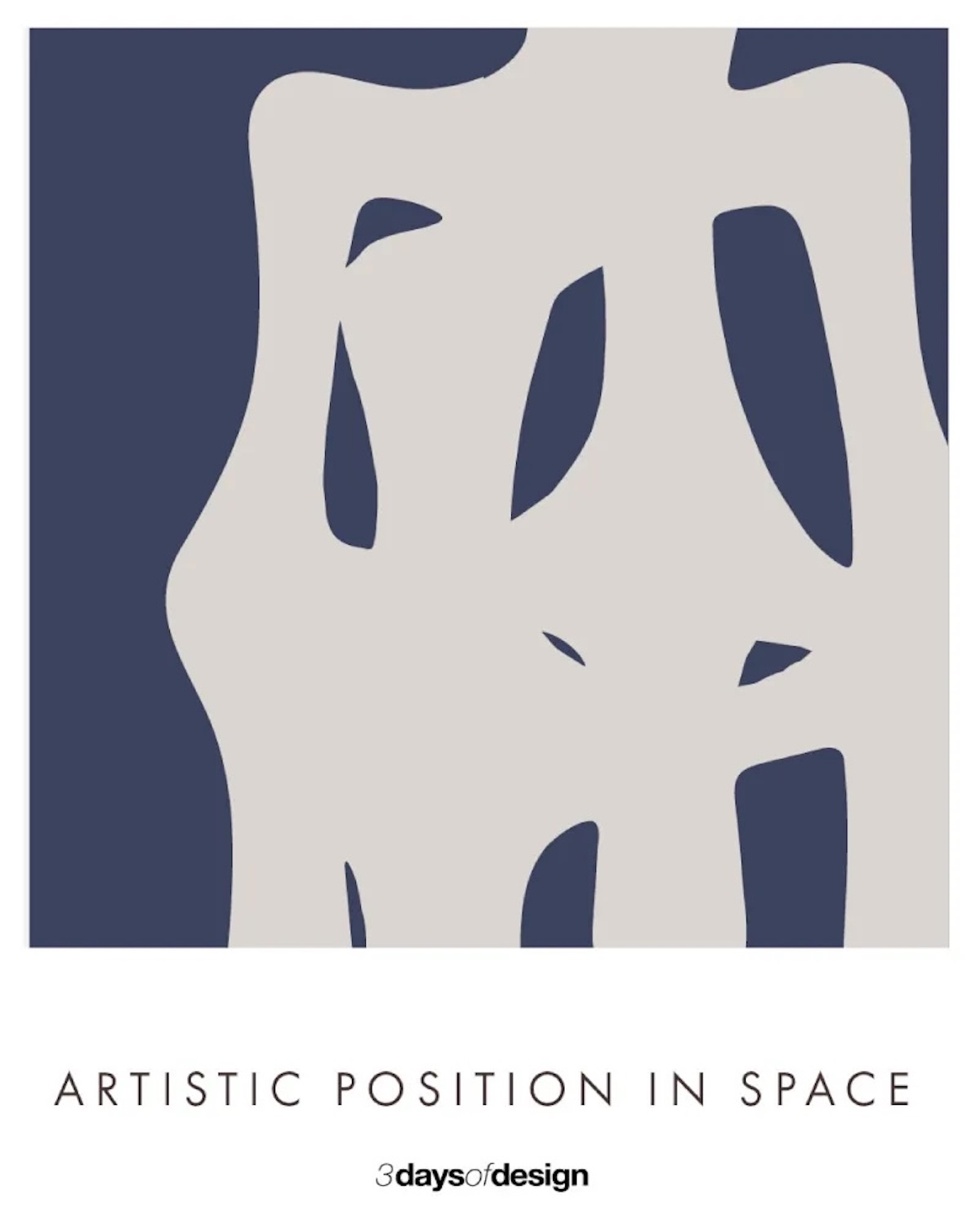
At 3daysofdesign in Copenhagen, running 10 to 12 June 2026, Agape and Agapecasa return alongside File Under Pop with Artistic Position in Space: a multi-studio installation, staged with V–ZUG, Davide Groppi and Garde Hvalsøe, that takes Le Corbusier's Villa Schwob as a spatial model and gives Agapecasa's re-edition of the Schwob Table its Northern European debut.
This year's festival theme, "Make This Moment Matter," turns on presence and intent, which is convenient because the installation is essentially an argument about where a thing should sit and to whom it should answer.
Most exhibitions are organised around objects. This one is organised around distances. Conceived as a sequence of domestic environments, Artistic Position in Space is built on the idea of Artful Living: a way of occupying a room in which objects, surfaces, artworks, light and materials are weighed as parts of one composition rather than catalogued as separate purchases. The home, read this way, becomes a field of relationships, each presence holding its own position, measure and identity.
The anchor is Villa Schwob, and the choice carries real weight. Built between 1916 and 1917 in La Chaux-de-Fonds for the industrialist Anatole Schwob, the villa is Le Corbusier's last major work of his Swiss period: a hinge toward the geometric abstraction, the structural use of concrete and the spatial research that would define everything that followed. It is also the building whose interiors, decades later, drew Angelo Mangiarotti and Bruno Morassutti into the story, which is precisely why it earns its place at the centre of a show about objects in a room.
For the installation, the villa is treated as a working model rather than a backdrop. The point of departure is its double-height hall, defined by a monumental window, an open visual axis and a low, modular arrangement that keeps the gaze travelling freely toward the outside. File Under Pop reinterprets this as an informal living room, where each element takes up a deliberate position within the whole.
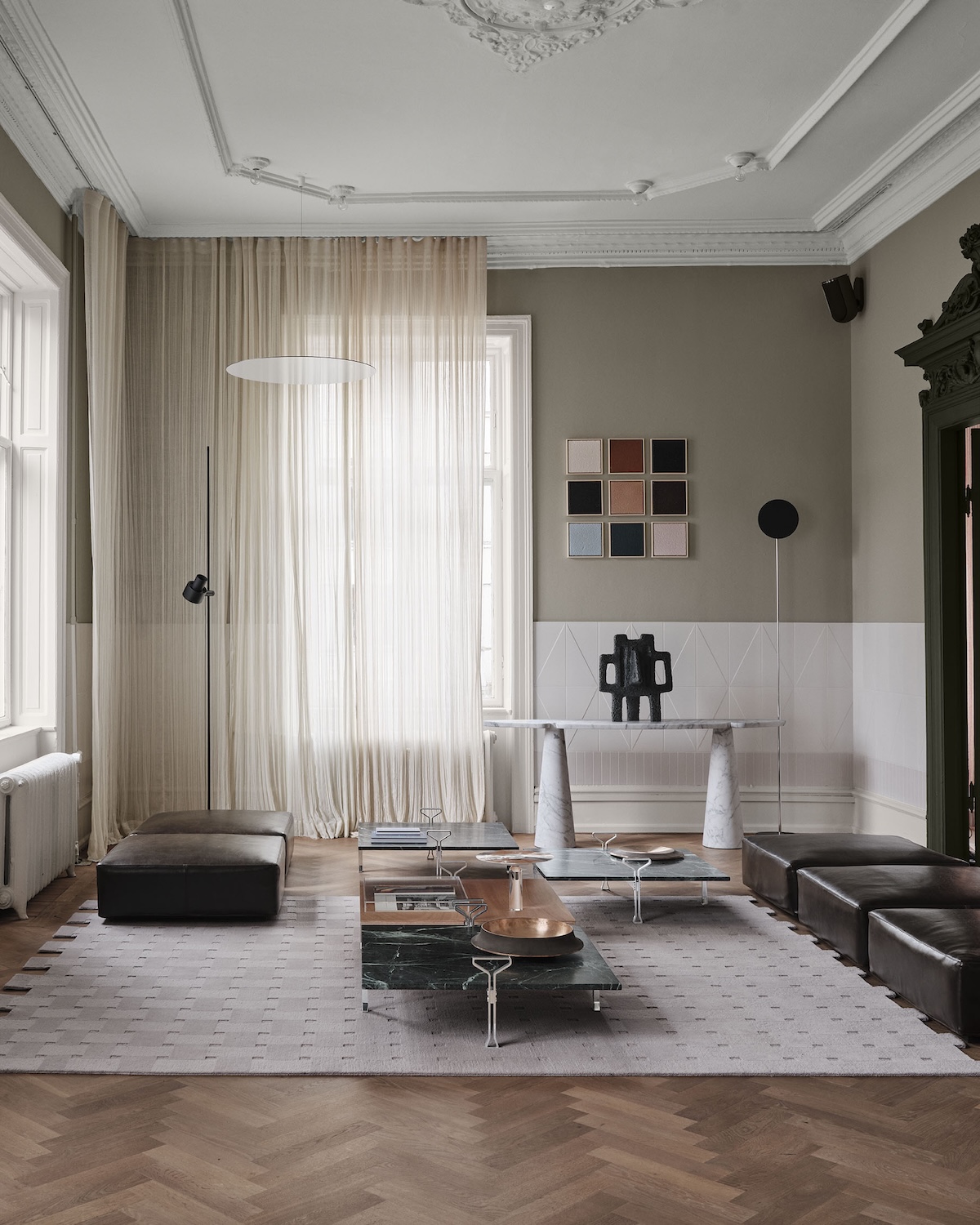
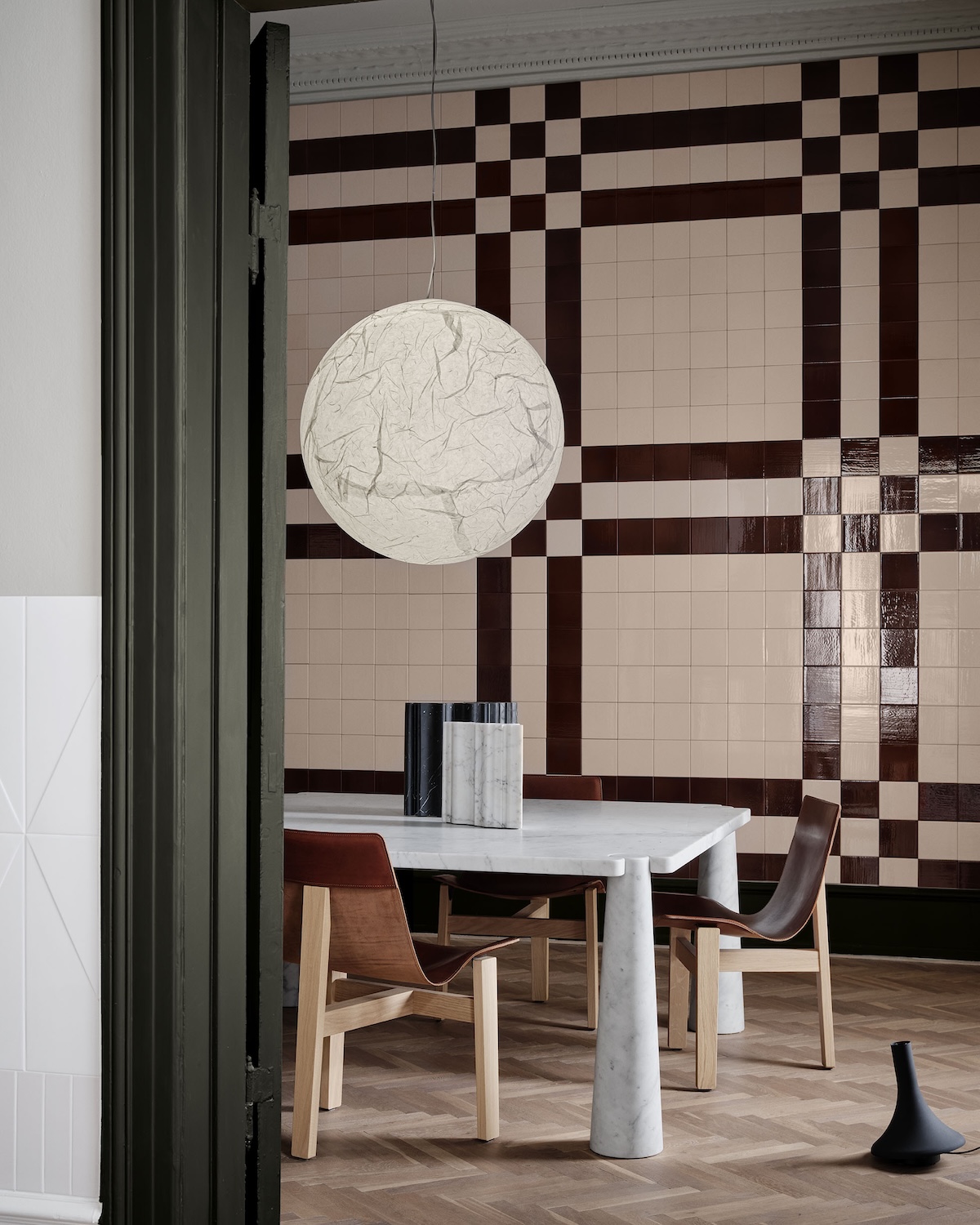
Within that setting, the Schwob Table becomes the natural point of convergence. Mangiarotti and Morassutti designed it for the villa when they were commissioned to rework the interiors, conceiving it for this same double-height hall. Its low geometry and modular presence hold the continuity of the room, while two side handles, integrated into the structure rather than added to it, turn the act of moving the table into a visible constructive sign.
Originally made in only a handful of examples and never put into industrial production, the table survived chiefly through photographs, drawings and period accounts. Agapecasa now presents a philological re-edition, faithful to the original proportions, workmanship and constructive intent. Making its debut in Northern Europe here, it is shown in various stones and okumè plywood, part of a wider reflection on architecture, material culture and the way a home is composed.
Around this origin point, Agapecasa stages a broader survey of Mangiarotti's work: Eros tables in several sizes, the Club 44 and Tre 3 chairs, and new configurations of the Cavalletto system. Limited-edition bronze CAP53 vases, in new variations, sit in display cases built into the Cavalletto structures, a quiet play between furniture and exhibition device. The new CAP53 pieces bring lost-wax casting back toward its original purpose, the making of sculpture; the form itself follows a single rule, that two circles of differing diameter, moving along the vertical axis, can generate a great many distinct objects from one principle.
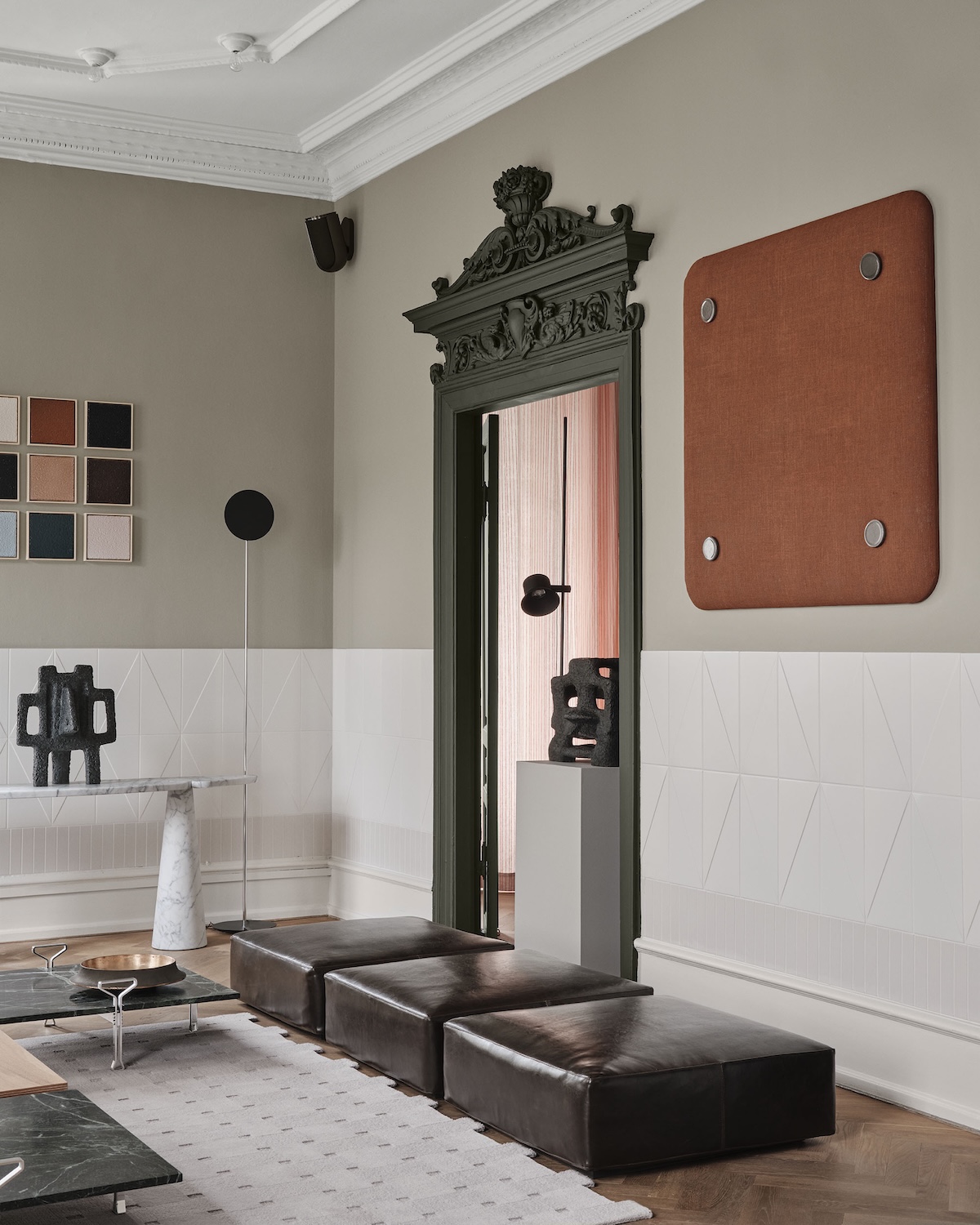
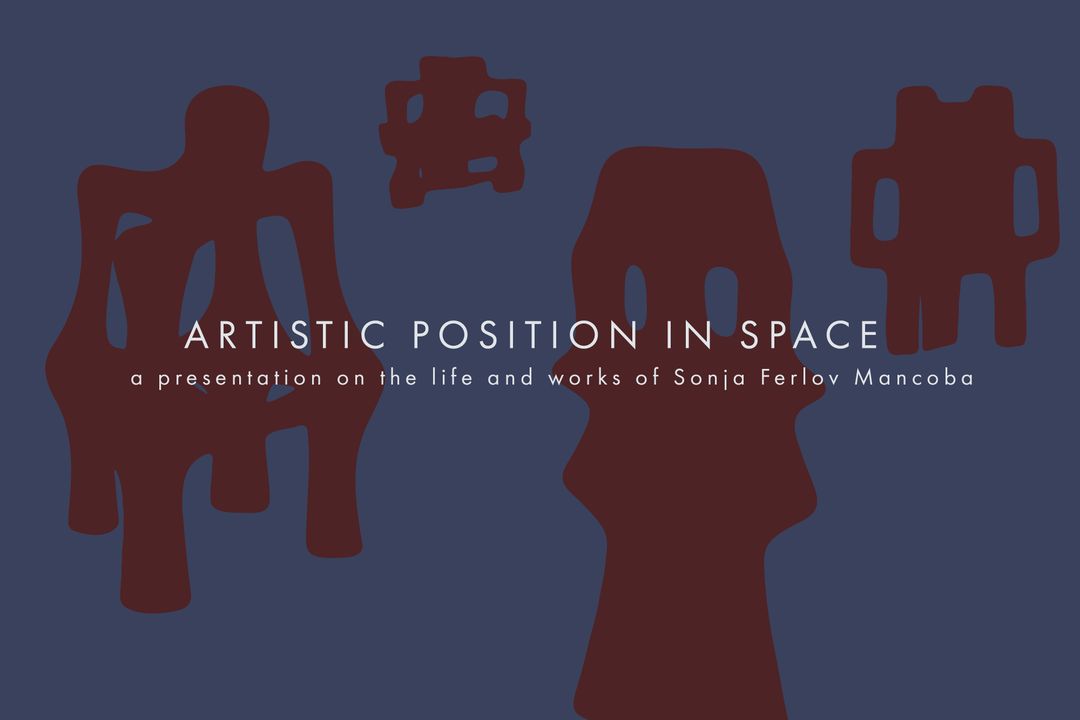
That bronze opens a direct material conversation with the sculptures of Sonja Ferlov Mancoba, whose work lends the installation further spatial and sculptural weight. Her own words supply the show its thesis: "Only through each other can we live and breathe – no one creates alone." It is a fitting line for a project in which several studios feed one shared environment while each keeps its own language intact.
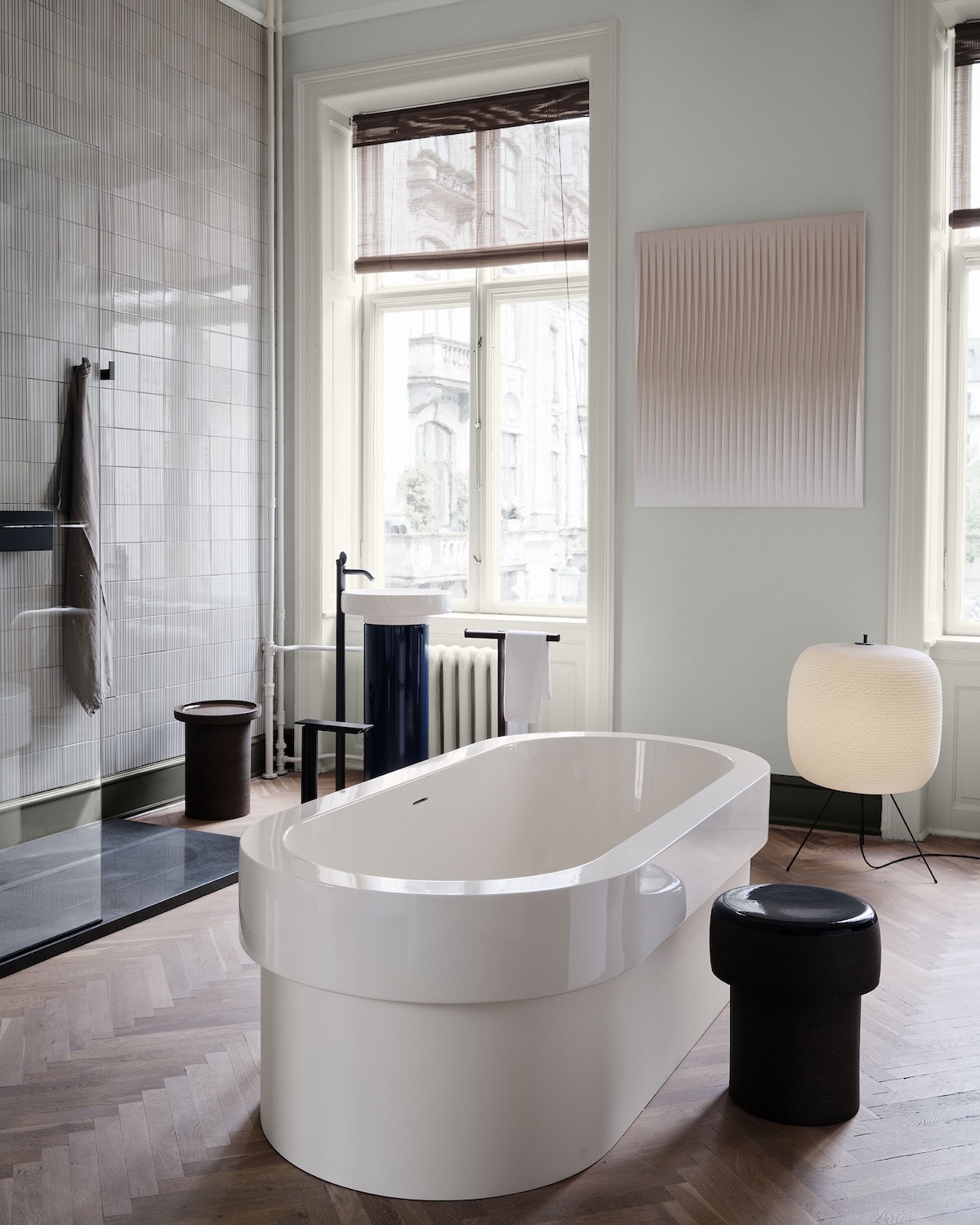
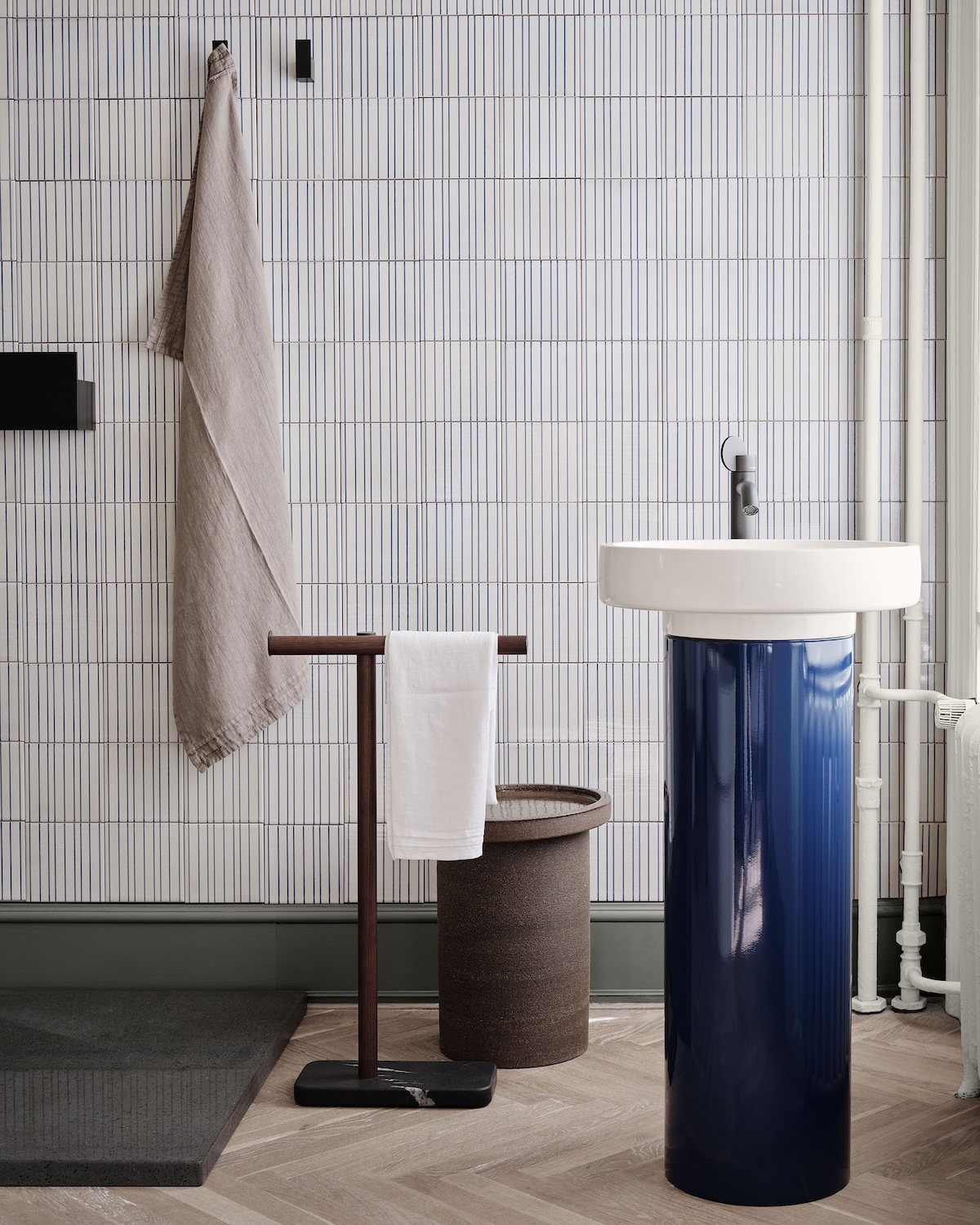
True to Agape's signature, the same logic runs into the bathroom, a domain the brand has long refused to file under "technical." Freestanding Lariana and Massicci washbasins are presented as sculptural presences, given the same attention to proportion, material and distance as the artworks and furniture around them. Their volumes shift the scale and the function, bringing the ritual of water into the living composition without quarantining it from the rest of the house.
A further environment extends the reading through the Bloque system, the Cenote bathtub and the Cenote washbasin. The bathtub, shown in a gel-coated solid-surface version in a colour developed specifically for the installation, anchors its space through mass, surface and tone; the Cenote washbasin carries the collection's narrative forward, while Bloque supplies an architectural framework for storage, surfaces and composition. Together they give the bathroom a central rather than peripheral role: not a service area, but a measured interior where water, object and architecture occupy the same field of perception.
Through the contributions of Agape, Agapecasa, File Under Pop and the participating studios, Artistic Position in Space resolves into a study of relationships: between furniture and sculpture, object and architecture, material and atmosphere. It is, in the end, less a presentation than a demonstration of its own title, a position in space defined by the way each element occupies, answers and quietly alters the room around it.
|
Name |
Schwob Table |
|
Design |
Angelo Mangiarotti & Bruno Morassutti, 1959 |
|
Re-edition |
Agapecasa, 2025 |
|
Structure |
Precision-machined polished natural aluminium |
|
Tops |
Okumè plywood; marble in Carrara, Nero Marquina, Carnico, Verde Alpi, Emperador Dark and Travertine, or special stones |
|
Dimensions |
650×650 / 800×800 / 1000×1000 mm |
|
Origin |
Conceived for the double-height hall of Le Corbusier's Villa Schwob |
|
Northern Europe debut |
3daysofdesign, Copenhagen, June 2026 |
What is Artistic Position in Space? A multi-studio installation by Agape and Agapecasa with File Under Pop, presented at 3daysofdesign in Copenhagen alongside V–ZUG, Davide Groppi and Garde Hvalsøe. It rebuilds the double-height hall of Le Corbusier's Villa Schwob as an informal living room and stages furniture, sculpture and bathroom pieces as a single spatial composition.
Why Villa Schwob? Built in 1916 to 1917 for Anatole Schwob, it is Le Corbusier's last major work of his Swiss period and a turning point toward his mature concrete-and-geometry architecture. Its interiors later drew Angelo Mangiarotti and Bruno Morassutti into the story, which makes it the right model for a show about objects in a room.
What is the Schwob Table? A low, modular table designed by Mangiarotti and Morassutti for the villa, made in only a few examples and never industrially produced. Agapecasa now presents a philological re-edition, faithful to the original proportions and construction, debuting in Northern Europe in stones and okumè plywood.
What are the CAP53 vases? Limited-edition bronze vases by Mangiarotti, shown in new variations and cast by the lost-wax method. Their form follows one principle: two circles of different diameter moving along a vertical axis, capable of generating a wide family of objects.
When and where? 3daysofdesign, Copenhagen, 10 to 12 June 2026, at File Under Pop.
Read more about the founders of AGAPE and their story: The alchemists of bathroom design.
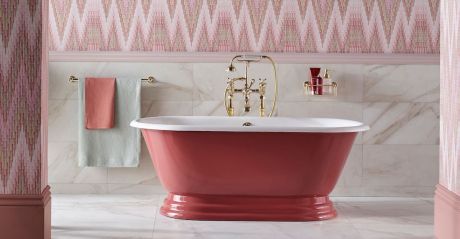
Set up in the 1980s, by Drummond Shaw, the company began as a vintage salvage company, restoring old rolltop baths to a characterful beauty, perfect for upmarket interiors and of course, indulgent deep soaks.
read more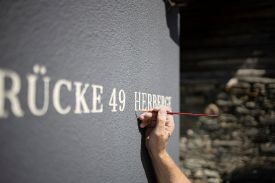
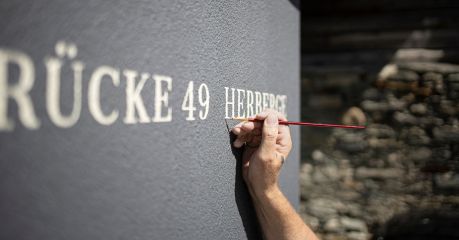
Ruth’s original manifesto to listen to what the house wanted to be has served her well. Reinvented for the curious traveller, Brücke 49 has been welcoming guests for nearly a decade.
read more
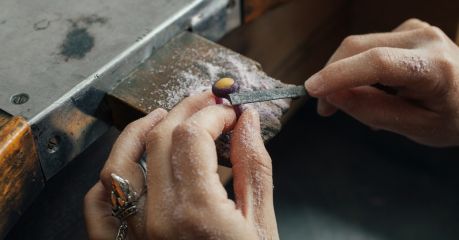
Madrid’s design culture is shaped by a new generation working close to materials and making, spanning furniture, fashion, sustainability-led studios and major annual design events in a production-led contemporary city.
read more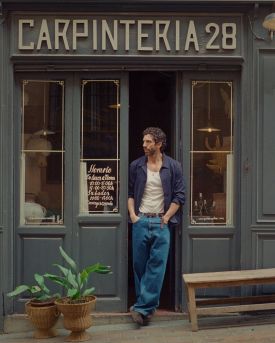
Working from Malasaña, Javier Sánchez Medina creates contemporary objects from natural fibres, guided by esparto grass, inherited craft knowledge and a deep respect for material, process and time.
read more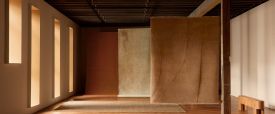
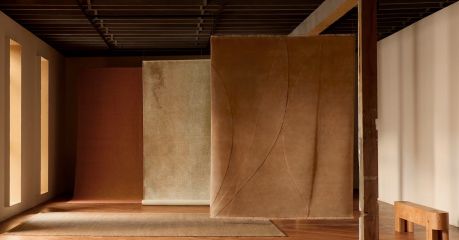
A Barcelona artist. Master weavers in India. A process the rug world has never seen before. Armadillo's Gaia collection exists somewhere between craft and fine art.
read more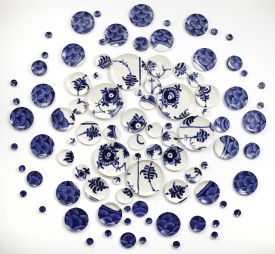
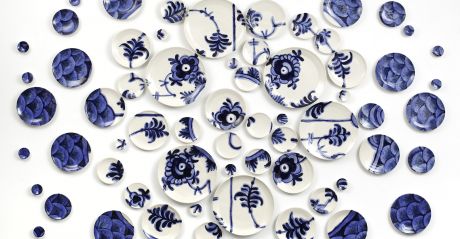
A city of effortless cool & pioneering Scandi design Copenhagen has long been at the heart of the world’s ceramics stage, from practical to the performative.
read more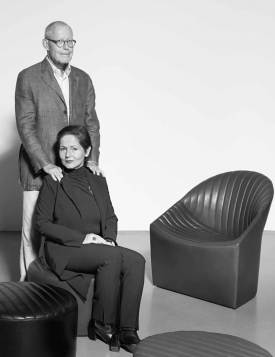
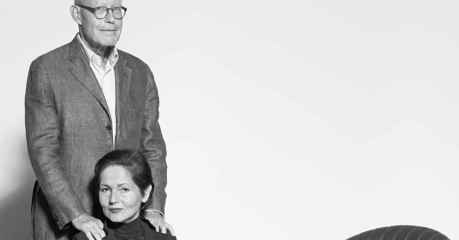
Cult furniture brand Wittmann has accumulated a distinctive mark over four generations, working with Austrian and international designers and architects, from Josef Hoffmann and Friedrich Kiesler to Matteo Thun and Edward B.Tuttle.
read more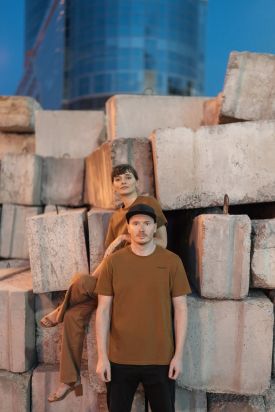
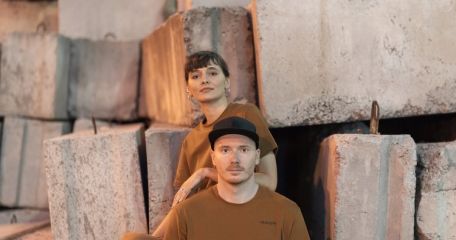
Trading in Kyiv, Ukraine since 2014, by husband-and-wife team Dan Vakhrameyev and Kateryna Vakhrameyeva, the co-founders of +kouple bring sleek lighting, innovative solutions and a Scandi-inspired design element to interiors.
read more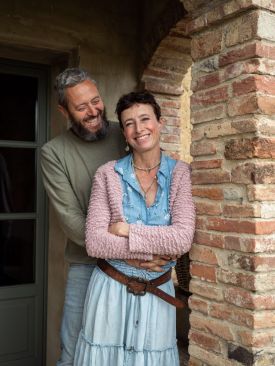

As the property neared finishing, Fabio took the decision to keep the garden wild and naturally indigenous – where the boundaries between garden and rural countryside were blurred.
read more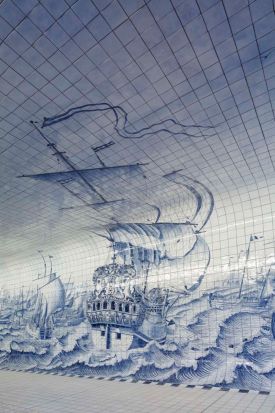
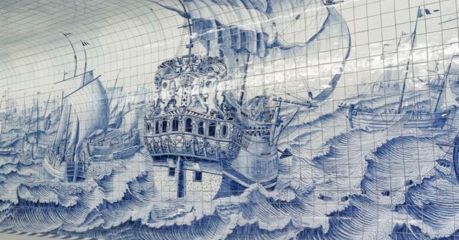
The oldest ceramic company in the Netherlands, Royal Makkum Tichelaar’s roots go back to 1572 - today they work alongside architects, designers and artists to continue their legacy.
read more

De La Espada leads a new era of collectible design and cultural craft. Explore their collaborations with Sam Baron, Anthony Guerrée and more, rooted in Portuguese savoir faire.
read more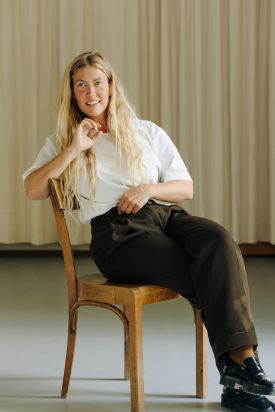

Seashells, old Christmas trees, and bio-textiles – Bonnie Hvillum pioneers biodegradable design, collaborating from Big Beauty Store Hackney to ÅBEN Brewery, Noma, Calvin Klein, Moskal, and Rita Trindade of Through Objects.
read more
Get the insider news and lowdown on what we've been up to, where we've been, and who we've met along the way. Be the first to discover new places and get the scoop on our favourites.